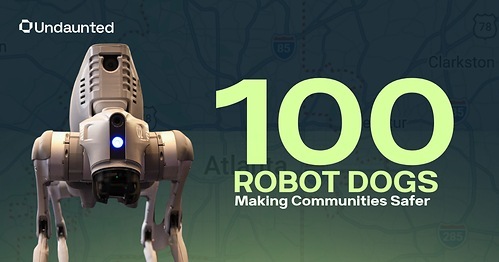
Robotic security can move the person operating a patrol away from the place being inspected. That is a change in the delivery of a human service even when the robot does not independently decide what to do. Understanding that distinction helps property managers assess staffing, supervision and response without assigning autonomy to a system whose supplier describes people at its controls.
In a release carried by PR Newswire on October 21, with an October 20 dateline, Undaunted says it has more than one hundred security robots deployed across metro Atlanta. The company describes human-controlled patrol robots combined with existing property cameras and real-time monitoring. It is preparing expansion into Houston and Dallas–Fort Worth. The Atlanta milestone is the reported current footprint; the Texas locations are a plan, not additional operating deployments established by the notice. Read the primary source account.
Scale belongs to an operating arrangement
The reported fleet count is evidence of the company's statement about deployment scale. It does not by itself show how many robots operate simultaneously, how support is staffed or what proportion of requested patrols is completed. Those questions matter when translating a fleet milestone into service capacity. A hundred installed devices can represent several operating patterns depending on schedules, site needs and maintenance.
Undaunted's description keeps trained personnel central to judgment. Moving an agent behind a screen can separate observation from physical exposure while leaving decisions and escalation with people. The service should therefore be assessed as a combination of remote work, on-site equipment and whatever response follows an observation. Calling it a fully autonomous guard replacement would erase the operating model described in the source.
Existing cameras also matter to that model. A robot is one observation point within a wider property system, rather than necessarily the origin of every useful image. An assessment that credits the robot with the complete result would need to distinguish what came from fixed cameras, the remote agent and the mobile patrol. The announcement does not provide that division for every cited incident.
Crime changes need more than a before-and-after headline
The release includes examples of falling crime and lower costs at particular properties. These are supplier-selected accounts, not an independently controlled comparison published with the announcement. A change after installation can be important to a property owner without establishing how much was caused by the robot service rather than other changes in the site, reporting or policing.
A stronger comparison would preserve the period observed, the offences counted and the relevant baseline. It would also make clear whether the figures concern the property itself or a wider surrounding area. This is an analytical requirement for interpreting the claimed outcomes, not a finding that the examples are inaccurate. The public release does not supply enough detail to derive a general prevention rate for other customers.
The same care applies to an evidence-assisted arrest. Useful recorded information can support an investigation, but that is a different outcome from preventing an incident. Both may matter to a customer. Keeping them distinct makes it easier to decide what the service is intended to improve and which measurements would establish that improvement over time.
Expansion tests the support model
A concentrated local fleet can create repeated experience with similar environments and a geographically bounded support operation. Moving into additional cities introduces a new test: whether training, remote operations, maintenance and local response arrangements can deliver the same defined service. The announcement identifies the next intended markets but does not publish completed service results from them.
For prospective customers, the useful immediate information is therefore the operating model and reported Atlanta deployment count. A purchasing comparison would need the actual coverage schedule, responsibilities when equipment is unavailable, escalation process and the scope of the service price. A headline comparison with traditional guarding does not substitute for matching those obligations to a particular property's needs.
Residents are also part of the service environment. An audible intervention or a remotely observed encounter can affect people who are not customers. An intelligible explanation of how personnel use the robot, how an incident reaches a responder and how questions can be raised would help make that operating model assessable. The source's positive customer quotation is one account of reception, not a representative resident survey.
The wider significance of the milestone is the possibility of a repeatable remotely delivered patrol service at more sites. Its value depends on dependable operations and appropriately interpreted outcomes, rather than a robot count alone. The next useful evidence is comparable service performance as the company expands, with human control retained explicitly and supplier-selected crime examples kept within their documented limits.
Source organizations: Undaunted.
References
Questions, news tips or corrections? Contact [email protected].