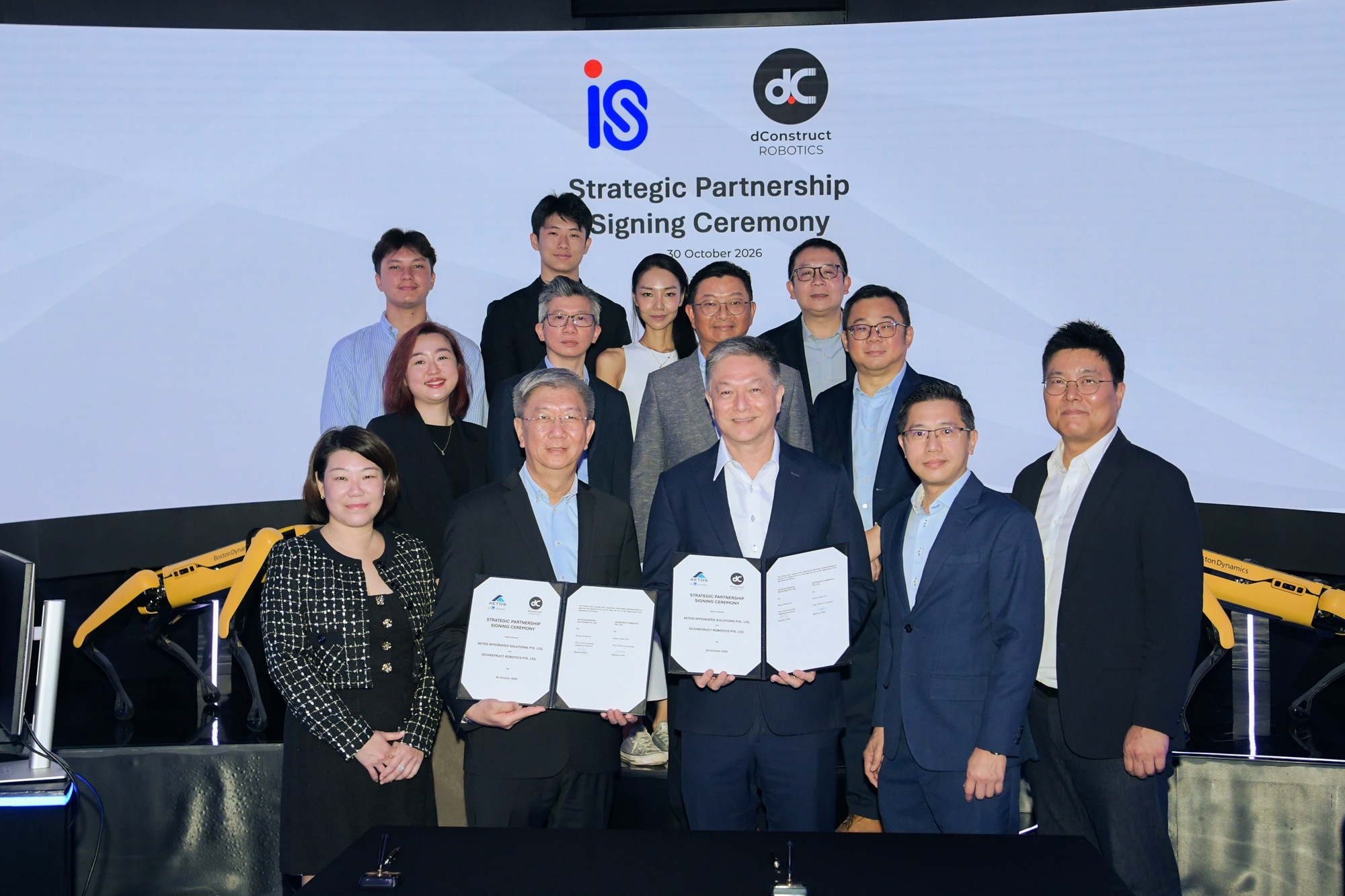
A patrol robot becomes useful when the information it collects changes a security team's next decision. Walking a route is only one part of that service. Someone must decide which observations matter, verify an alert and coordinate a response. A partnership that explicitly includes those responsibilities offers a more informative development milestone than a robot demonstration alone.
AETOS and dConstruct Robotics have entered a teaming agreement to develop, validate and deploy autonomous security services, SJ Group announced on October 30. A first phase at an operating site in Singapore is expected in the first quarter of 2027. The announcement describes future development and assessment, rather than a completed multi-site rollout or an independently measured improvement in incident response. AETOS is the security business of SJ Integrated Solutions. Read the primary source account.
Two software responsibilities surround the robot
The proposed service uses Aquila-X as its command and control environment, built on SJ's 24K digital platform. dConstruct's d.ASH handles missions, fleet condition and sensor information. That division matters because the system managing a robot's route does not necessarily own the final security decision. The announcement makes operator workflows and response protocols part of the joint development, alongside integration, mission logic and detection settings.
Under the planned concept, robots can follow scheduled patrols or gather further information after an alert. Initial missions include after-hours perimeters, car parks, common areas, plant rooms and utilities. Cameras and LiDAR are listed, with thermal, acoustic or environmental sensors where the mission requires them. AETOS personnel would assess the information through established security processes and decide the appropriate response.
Boston Dynamics' Spot is the initial principal platform, while the partners intend to assess complementary robots for different sites. A common operating service therefore need not mean identical hardware everywhere. It does require a reliable account of which platform carries which sensors, what an alert means and what a receiving operator can ask it to do. Changing that combination changes the service that needs assessment.
Outcome measures make the next phase inspectable
The companies name patrol coverage and completion, availability, alert-to-verification time, false alarms and response time as first-phase measures. Those categories are more useful than a single claim of increased efficiency. A robot might complete most routes while producing too many alerts, or improve verification while requiring substantial maintenance. Keeping the measures separate allows the receiving customer to see those tradeoffs rather than lose them in one score.
A meaningful coverage record would also distinguish a scheduled route from the observations actually obtained. A blocked doorway, unavailable sensor or incomplete patrol can leave a different information gap even when the fleet dashboard remains online. This is an implication of assessing the proposed service, not a claim that the partners have encountered those failures. The first-phase findings should show how exceptions are recorded and handed back to staff.
Timing deserves similar care. An alert can arrive quickly yet take longer to verify if the picture lacks context. Conversely, a robot may need extra time to reach a useful vantage point while reducing uncertainty for the eventual responder. Recording detection, verification and response as separate events would show where the service contributes, without assigning every change in an incident's duration to autonomous movement.
Integration includes the receiving organisation
The announcement links the initiative to security contracting based on outcomes rather than prescribed staffing. That places more weight on how a customer defines an acceptable result. A coverage requirement, a response expectation and an availability commitment describe different obligations. The public agreement does not publish a customer contract or guarantee that one standard can be carried unchanged from a car park into an airport or industrial facility.
The partners also identify cybersecurity, data governance and accountability as design concerns. The operating distinction is practical: a fleet can collect useful video while still needing rules for who accesses it, how an event is escalated and what happens when a connection is unavailable. These questions belong to the service's design and validation; they are not answered simply by describing a platform as AI-enabled.
The immediate change is a named development arrangement with an intended start window and observable assessment categories. Wider expansion remains conditional on validation and site requirements. If the Singapore phase produces a clear record of coverage, false alarms, verification and human response, it could make the service easier to assess across other locations. The next persuasive evidence is that record, attached to the actual platform and operating configuration.
Source organizations: AETOS, dConstruct Robotics, Boston Dynamics.
References
Questions, news tips or corrections? Contact [email protected].