Adding an autonomous aircraft to a public-safety team changes more than its camera coverage. People, animals and existing equipment must share a noisy, constrained environment while attention is already divided. A capability that works well alone can create a new source of uncertainty when introduced to a team that has never trained with it. That is why the integration burden deserves as much attention as the aircraft specification.
The stakes extend beyond the operator. Better remote observation might help a team understand an uncertain scene without immediately bringing everyone closer. But an unfamiliar machine can also distract the people or working animals expected to use that information. The relevant question is whether the combined system is more predictable, not whether each individual component is impressive.
A session aimed at the gap
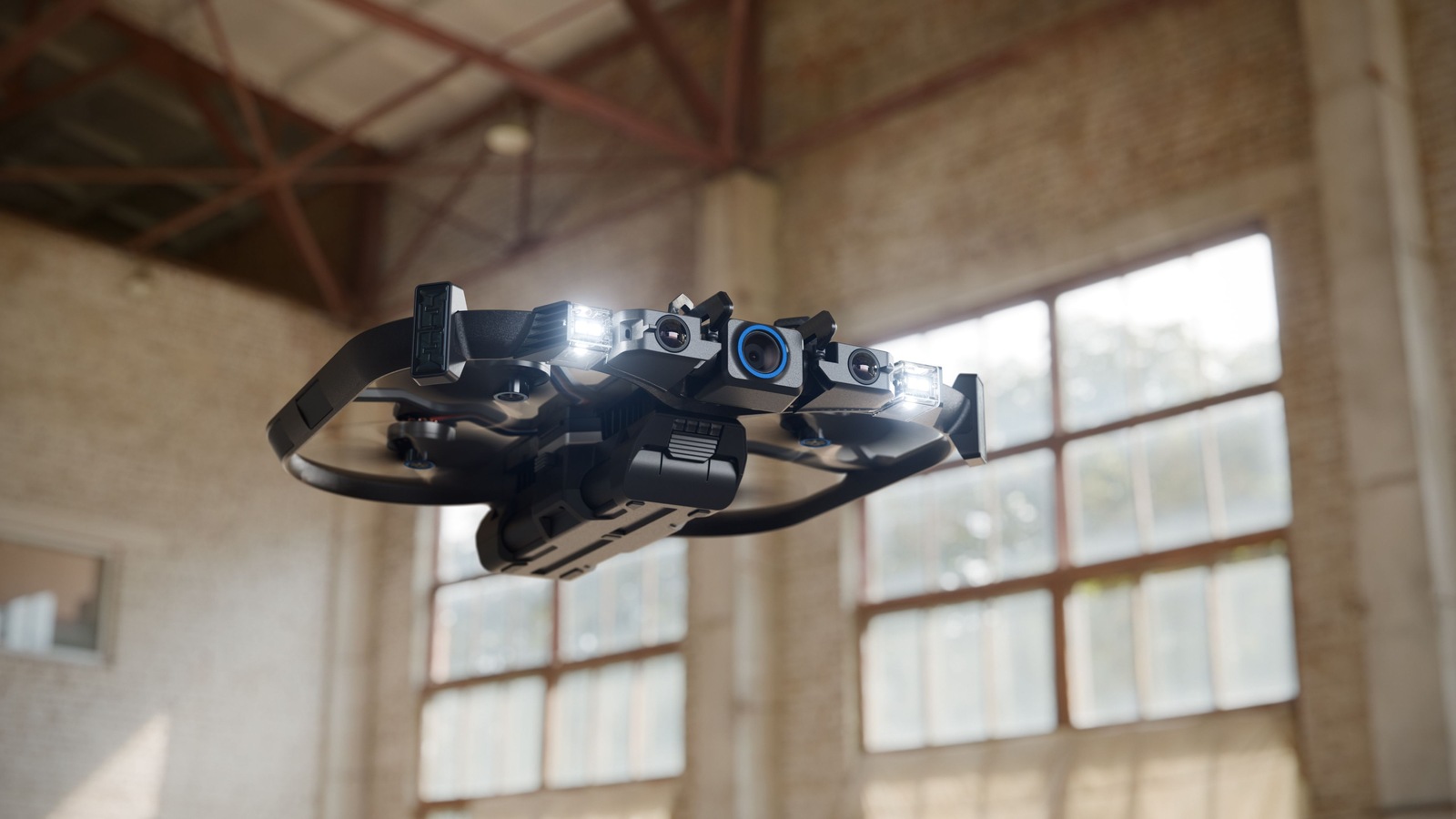
On October 12, Skydio described an exploratory training session involving its R10 indoor drone and K9 teams working with Trident K9 Consulting. The session took place at Skydio headquarters in a training building and parking garage. The company said it is developing a formal curriculum from the observations. This is a training-development account, not a completed comparative study or a validated operational protocol. Primary source.
Skydio describes the R10 as using vision-based autonomous navigation for GPS-denied spaces, with obstacle avoidance and the ability to retrace its path. The report’s distinct contribution is the recognition that aircraft autonomy does not remove the need to prepare the rest of the team for its presence.
Watch the system in action
Official source video from Skydio; company demonstration rather than an independent performance trial. View the source ↗
Compatibility is a system property
An aircraft can avoid an obstacle while still disrupting another participant. Navigation software is concerned with the machine’s path; a handler is concerned with an animal’s attention and welfare; a supervisor is concerned with whether the observation changes a decision. Those concerns overlap but are not interchangeable.
This makes integration testing different from a product demonstration. A demonstration can show a successful flight and stop there. A training program needs to expose variation, interruptions and uncertainty without treating any one successful session as representative. Differences among working animals, handlers, spaces and acoustic conditions could matter even when the aircraft behaves consistently.
There is also an information problem. A new aerial view does not guarantee that every person receives or interprets it in time. Someone may be watching the feed while another person is making a decision using older information. Assessment should therefore examine communication and workload alongside navigation. These are editorial evaluation questions, not claims that this session measured them.
What the report cannot establish
The company account does not provide a controlled comparison, a sample size sufficient to generalize or a published incident-outcome evaluation. It does not show that a training curriculum is finished. Nor does it establish that combining the systems always improves safety for officers, working animals or members of the public.
It is reasonable to treat the observations as a starting point for curriculum design. It would be unreasonable to treat them as proof that an agency can skip its own review. Product availability, trained participation and permission to operate are separate conditions. The session addresses a part of readiness, not all of it.
What agencies can do differently now
The immediate change is to the planning assumption. Budgeting for an aircraft alone leaves out familiarization, joint exercises, supervision and evaluation. An agency assessing indoor drones can ask whether its existing training covers the people and other capabilities likely to share the environment. It can also ask who is responsible for stopping an exercise when interactions become unclear.
Procurement should leave room to learn that a combination is unsuitable in some circumstances. A system with a well-defined limit may be more useful than one sold as universally complementary. Training records should preserve adverse observations as well as successful flights, because a curriculum built only from the latter will exaggerate readiness.
This need not become a claim that more equipment is always the answer. Earlier observation may sometimes reduce the need to introduce another capability at all. The service should be evaluated on the decisions it improves and the risks it avoids, rather than on how many tools it can bring together.
A wider definition of autonomy readiness
If a formal curriculum produces repeatable, independently reviewable evidence, this work could help shift drone adoption from individual pilot proficiency toward team compatibility. That would make training and human factors part of the product’s practical value. Without such evidence, it remains a sensible hypothesis supported by an exploratory session.
The next thing to watch is the curriculum itself: its scope, how it handles variation, how observations are recorded and whether outcomes are evaluated beyond company demonstrations. The larger promise is better-informed public-safety decisions. The test is whether adding autonomy makes the whole team easier to understand and oversee.
Primary source: Skydio official reporting.
Questions, news tips or corrections? Contact [email protected].