A perimeter sensor is useful when it tells a team where to look and does so consistently enough that operators continue to trust its alerts. Detecting a disturbance is only one part of that task. The system must distinguish relevant events from environmental effects, preserve location and continue to make its own condition understandable when the installation is damaged.
Senstar’s September 14 FP1500 announcement describes a fence- and wall-mounted fiber-optic sensor using coherent Rayleigh scattering and a neural-network disturbance classifier. The company claims location precision within three metres, detection of simultaneous events and a cut-immune configuration. It also reports typical detection and nuisance-alarm figures. These are attributed supplier specifications, not independently established results for every fence, weather condition or customer installation. Read the primary source account.
The installation is part of the sensor
A fence transmits vibration according to its construction, condition and surroundings. A sensor’s behavior therefore needs to be tested on the installation it will protect. A laboratory or reference result can be informative while leaving the customer’s mounting, vegetation and background disturbances as separate variables. The release does not provide a complete public dataset spanning every site type it lists, so no universal alarm-rate guarantee is inferred here.
An illustrative evaluation could include a planned intrusion attempt and a set of ordinary environmental disturbances, with the event types and conditions recorded. This is a suggested assessment, not a description of a completed FP1500 customer trial. The useful record would show both detected attempts and incorrect alerts over a stated observation period. A successful selected event alone would not establish the rate at which a security team can expect nuisance alarms.
The classifier’s output also needs to remain useful to the operator. The supplier lists event categories including fence climb, fence cut, ladder climb and unknown. An unknown classification can preserve uncertainty rather than force an unjustified label, but the customer needs a response process for it. The announcement does not publish a complete operational policy for every category. A sensor classification should support verification, not be treated as a final account of what happened.
Resilience depends on the stated configuration
The cut-immune claim is tied to a configuration using two sensing fibers routed in opposite directions. That condition should travel with any description of continued operation after a cut. It would be misleading to apply the claim to an unspecified single-ended installation or to every possible combination of damage. A useful acceptance test would identify the installed topology and report the fault indication as well as the remaining detection coverage.
The source describes passive optical field components and reduced needs for outdoor power and grounding. Those design attributes can change installation and maintenance work, but the complete system still includes processing, interfaces and a response arrangement. A buyer should compare that whole configuration rather than assuming that a passive sensing element makes the entire security service maintenance-free. The release does not publish a complete lifecycle-cost comparison for every alternative perimeter technology.
Integration options include interfaces intended to connect the sensor to video and security-management systems. An available interface is different from a tested connection to a customer’s actual software version and operating procedure. A meaningful demonstration would show a located event reaching the receiving system with its time, classification and sensor-health state intact. These are proposed acceptance criteria, not independently verified interoperability results supplied with the launch.
Cybersecurity statements also need precise scope. The company lists security features and references standards in its product description. This article does not convert that wording into an independently verified certification or a blanket legal compliance determination. Customers need the relevant documentation for the exact product and configuration. The technical point remains that a perimeter sensor joins the security network and its information must be both operationally useful and supportable over time.
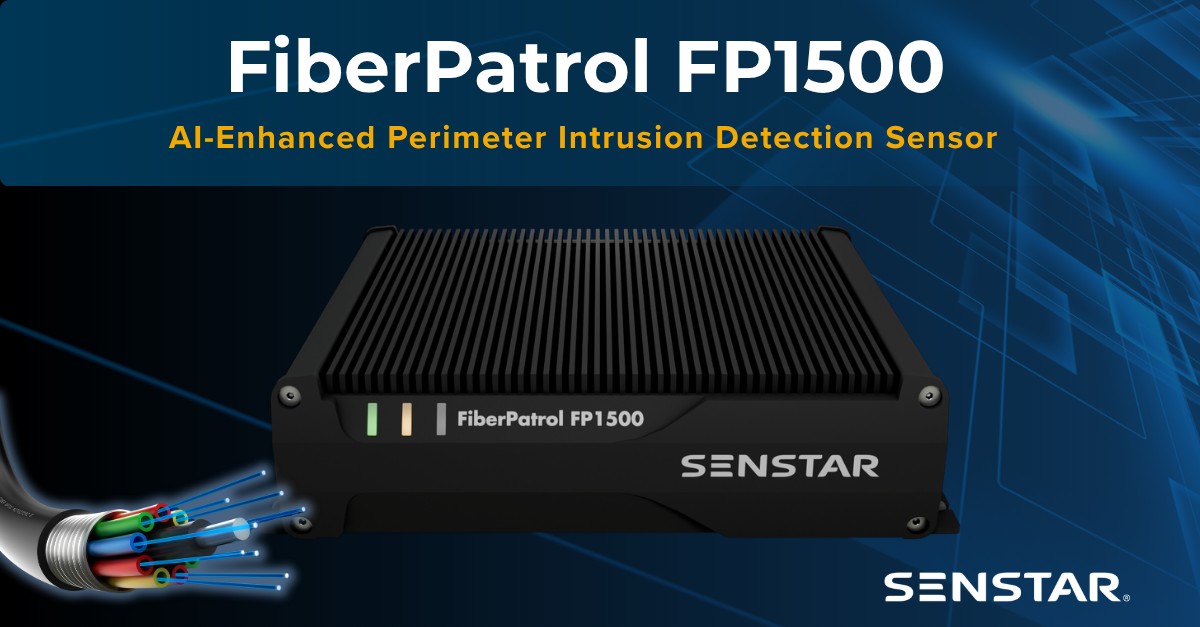
The accompanying product artwork identifies the announced sensor and is labeled as supplier material. It does not show the conditions used to obtain the stated detection figures or independently demonstrate performance on a customer’s fence.
The next evidence is an installation-specific operating record with the configuration, conditions and event denominator retained. FP1500’s launch supplies a defined sensing approach and testable supplier claims. Its security value will depend on whether location and classification help a team investigate relevant events consistently, with nuisance alarms and damage states reported as carefully as selected successful detections.
References
Questions, news tips or corrections? Contact [email protected].