A drone can collect a clear image while leaving the receiving team uncertain about which asset it shows or whether it represents a change. Combining many collection systems makes that interpretation problem more important. A useful inspection platform must retain the source, time and operating context that make an observation actionable.
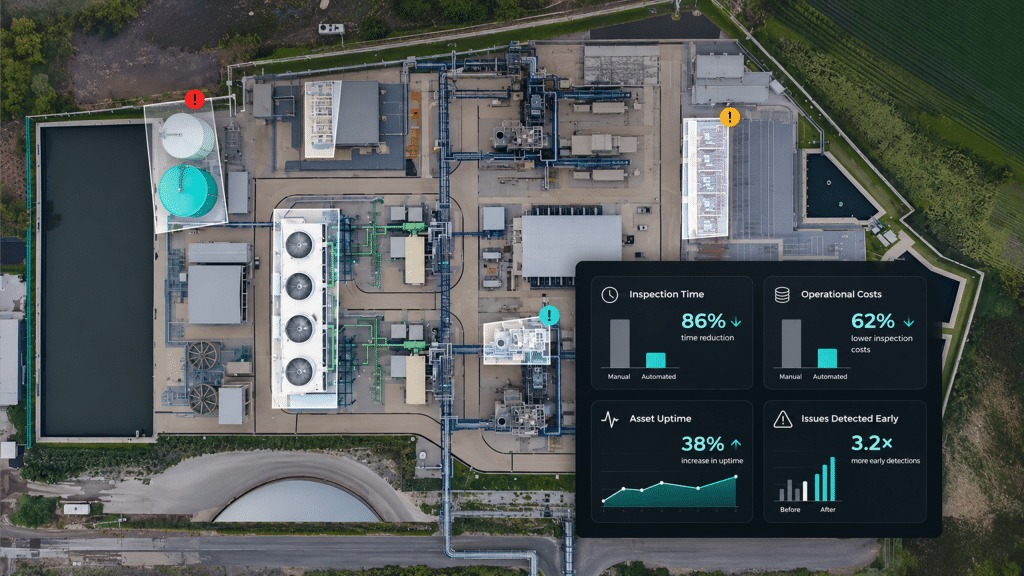
Percepto’s October 27 Axion launch describes a software service that accepts supported third-party drone and sensor data alongside its own collection systems. The company says it organizes findings by asset and combines inspection history with contextual analysis. These are supplier descriptions of an available platform, not independent measurements of accuracy across every supported input. Read the primary source.
A supported input is not an equivalent measurement
Hardware independence changes the integration boundary. Two cameras can observe the same equipment with different viewpoints, resolution and temperature sensitivity. A common interface should not make their measurements appear interchangeable. The platform needs to preserve enough provenance for a reviewer to understand what was actually observed.
A useful acceptance exercise would follow a known asset across different collection sources and a later revisit. It should test whether the system retains asset identity, distinguishes a new anomaly from an old one and explains an uncertain match. A visually convincing dashboard cannot establish those properties on its own.
Connect the finding to the asset
The handoff to maintenance matters as much as the initial detection. An alert needs a responsible recipient and a record of whether it was reviewed, deferred or converted into work. Closing a software ticket is distinct from confirming that the physical condition changed; both events should remain visible.
Existing archives may provide a practical starting point, but they also contain gaps and inconsistent collection practices. Adding them to a new platform does not retroactively produce a uniform inspection program. Teams need to establish what comparisons the history can support before treating every apparent trend as a physical change.
Watch the receiving workflow
The commercial comparison should also separate the cost of collecting new observations from the cost of making an old archive usable. A platform may accept a file without knowing the equipment identifier or inspection purpose that gives it meaning. Customers evaluating Axion could ask for a representative migration sample, including incomplete records, rather than only a clean demonstration set. The acceptance record would then show which historical comparisons remain defensible and which require a new baseline. That distinction helps prevent an inexpensive software integration from becoming an unacknowledged data-reconstruction project.
Responsibility for an analytical result deserves the same attention. If a finding changes after a source file is corrected, the receiving team should be able to identify the original interpretation, the correction and the people who acted on each version. Overwriting the earlier result might make the dashboard cleaner while obscuring an important decision history. This is a proposed criterion for assessing mixed-source inspection services, not a statement that the announced platform lacks such a record. The release alone does not establish the behavior of every downstream integration.
Procurement teams can make the comparison more informative by choosing a defined receiving decision before the trial begins. For example, they might assess whether a reviewer can distinguish a repeat observation from a newly discovered condition using the available history. The measure would concern a specific review task, with uncertain cases retained, rather than an undifferentiated count of findings. That design leaves room for the software to save useful effort without requiring a claim that every collection source has become interchangeable or that all review can be automated.
A broader market consequence could be less dependence on a single collection fleet, but only if the receiving organization can retain and export a useful inspection record. Support for an input format and portability of the resulting asset history are separate questions. An evaluation should examine both before assigning a long-term switching benefit to hardware independence. The strongest case would connect a supported source, a traceable interpretation and an accepted maintenance decision while preserving the limits of the underlying observation. That remains the evidence needed beyond the launch description.
The immediate opportunity is to evaluate an analysis layer without replacing every collection device. The wider possibility is a more coherent account of infrastructure condition across mixed fleets. That depends on reliable source-specific interpretation and a supported path from finding to response.
The next evidence is a customer-supported workflow showing accepted findings, uncertain cases and the resulting actions. A count of supported inputs describes reach; a traceable change in the receiving operation would establish whether that reach becomes useful visibility.
References
Questions, news tips or corrections? Contact [email protected].