A port can need a view of an incident before a patrol crew can reach it. Remotely launched aircraft change the time required to collect that view, but the result still has to reach someone able to interpret it and act.
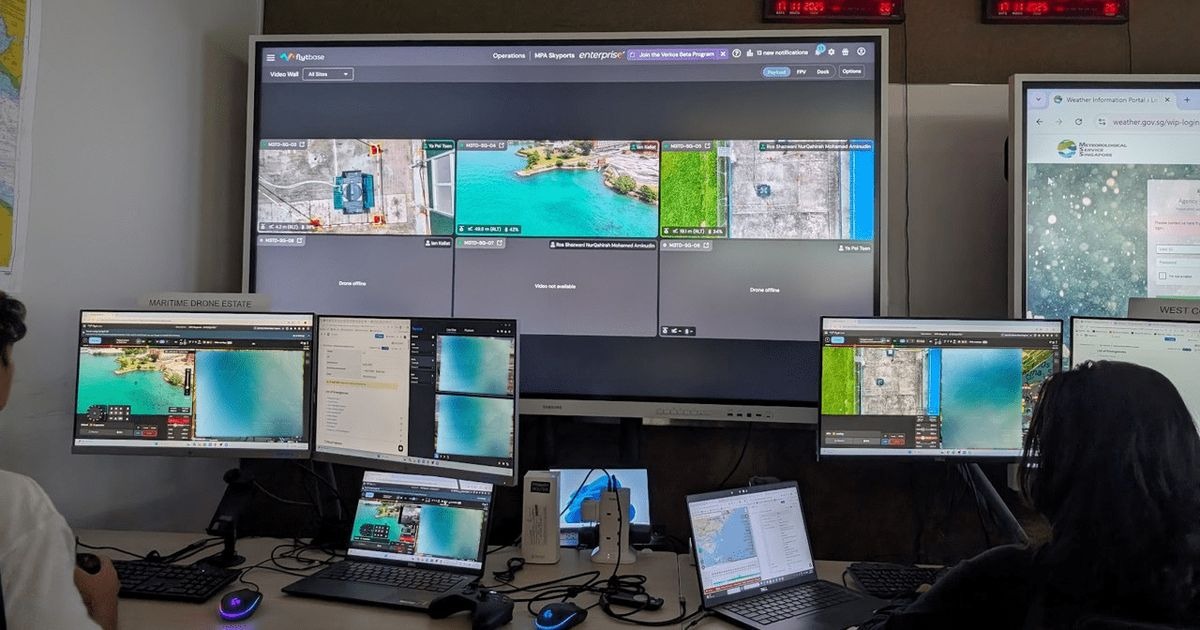
FlytBase’s July 22 account of Singapore Maritime and Port Authority operations reports up to an 80% reduction in drone deployment time and expanded coverage from roughly 400 meters to five kilometers. It links the underlying Skyports Drone Services case study. These are reported program figures from an earlier deployment account, not a new October trial or a controlled comparison of incident outcomes.
Identify where the clock starts
A launch-time improvement can remove travel and setup delays. A response-time improvement additionally depends on recognizing the event, requesting the aircraft, interpreting the observation and directing a crew. Treating those intervals as interchangeable hides where work remains.
The coverage figure also needs its operational conditions. A larger area is useful only when the aircraft, communications and available staff can support the required observations and permissions.
Connect collection to the receiving team
An evaluation should follow a sample of missions through the entire sequence and record unavailable launches, ambiguous observations and the final disposition. It should also distinguish scheduled monitoring from incident-driven flights, because their staffing patterns differ.
This case illustrates a concrete shift from transporting a pilot to a site toward managing a distributed collection service. The next useful evidence connects its reported launch advantage to reliable information delivery and the decisions that information changed.
Original source and reported conditions.
A useful time saving needs a defined denominator
The phrase deployment time can describe different intervals: time from a request to an available aircraft, time from authorization to launch, or time until an observer receives useful information. A comparison should state which interval changed. The reported percentage is meaningful within its original definition; it should not be relabeled as an equal reduction in the entire incident-response cycle.
The same issue applies to coverage. A distance describes one dimension of reach, while the useful observation area depends on the task, viewpoint and operating conditions. Wider reach may allow a team to inspect more places, but it does not mean every point is continuously observed. A reader should preserve that distinction rather than translating a range figure into a claim of uninterrupted surveillance.
Centralization moves work rather than removing all work
Remote operation can reduce repeated journeys to launch sites. It also requires preparation, supervision, maintenance and coordination with the team receiving the information. Those activities may be organized more efficiently in a shared service, but they remain part of its cost and capacity. Evaluating only the work removed from the waterfront would overstate the change.
A representative service review would include routine periods and periods when several requests arrive together. Average activity can look manageable while the busiest interval creates delays. The purpose of such a review is to identify the staffing and prioritization needed for the intended service, not to assume that every aircraft requires a dedicated operator or that one operator can absorb unlimited demand.
The earlier case remains useful within its date
This account is included as a source-based analysis of an established operating model, with the July source date kept visible. It does not claim that Singapore announced a new program today or that the reported figures have been independently updated. That date boundary matters because equipment, procedures and the scale of the service can change after the case study was written.
For another port, the transferable lesson is a question rather than a promised result: which delays come from sending people to equipment, and which come from reviewing information and organizing a response? Separating those delays helps a team decide whether remote launch addresses its actual constraint. The original case provides a concrete example to examine, while a local trial is needed to establish the achievable benefit elsewhere.
The distinction between a program account and a transferable result is essential here. Singapore’s operational setting, authorities and infrastructure shape what the reported system can do. Another organization can learn from the account without assuming those conditions exist at its own sites. A local evaluation should identify the comparable tasks first and then test the proposed operating arrangement. That preserves the useful lesson of the case while avoiding a common error in technology adoption: treating a percentage from one customer’s workflow as a forecast for an entirely different service.
References
Questions, news tips or corrections? Contact [email protected].