A counter-drone operator may need to investigate a signal before a system can confidently name the aircraft behind it. Treating every unfamiliar signal as harmless would miss emerging equipment, while treating all of them as confirmed threats would overload the response process. The useful interface needs to preserve the difference between a clue, an identified object and an authorized action.
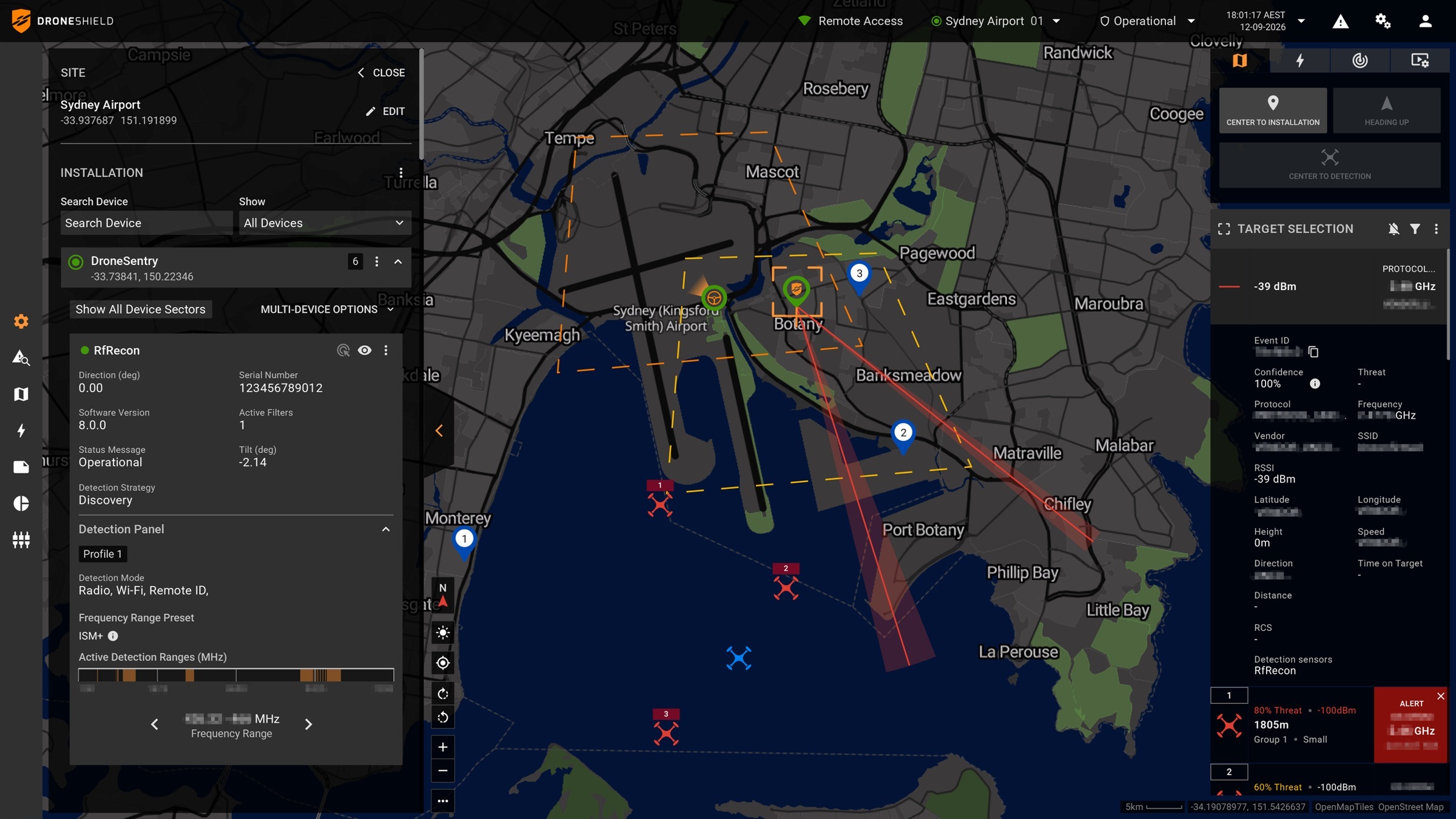
DroneShield's October 14 Q4 software announcement describes RfRecon forwarding drone-like signals absent from its threat library to the DroneSentry-C2 dashboard. It also covers camera tracking, classification changes and interoperability. The supplier states that the C2 release will be available on November 3. That future date remains relevant on October 31: the announcement should not be read as proof that every described function is already operating across the installed base. Read the primary source account.
Discovery creates a verification task
An unknown signal is an observation to investigate. Sending it to a dashboard can make that uncertainty visible, but does not establish the identity, purpose or authorization of an aircraft. The release includes filtering by frequency range as a way to focus analysis. A more informative operating record would show how the receiving team distinguishes useful leads from irrelevant signals without losing the original uncertainty.
This is a different value proposition from matching a known signature. A library can support recognition of previously characterized equipment, while discovery concerns something that does not yet fit that catalogue. Combining both may help an operator retain a wider picture. It also makes the classification label important: a discovery should not silently acquire the authority of a confirmed identification as it moves between screens or teams.
The supplier describes compatible optical cameras working with passive RF sensing, including Bosch Starlight camera direction and tracking. Layered observations can help a person inspect what prompted an alert. The claim concerns the specified passive sensing arrangement, rather than a guarantee that every complete installation uses no emitting component. The actual combination of sensors determines what information is available.
Performance percentages need their test conditions
The release reports a 44 percent improvement in thermal classification accuracy and improvements of 18 percent in fixed-wing precision and 8 percent in recall. It does not supply a complete independent evaluation protocol with the notice. The percentages therefore remain supplier-reported changes under undisclosed conditions, rather than absolute accuracy values that a customer can assume for every target and environment.
Precision and recall answer different questions. One concerns the reliability of positive identifications; the other concerns how much of the relevant population is detected. A gain in either becomes more interpretable when the target set, thresholds and baseline are retained. That explanation does not independently verify the reported improvements. It shows what additional evidence would connect them to a particular security requirement.
For an operating team, false alerts also create work. A detector can improve on a benchmark while still requiring careful verification at a busy site. An acceptance comparison would preserve representative background activity and record the resulting operator burden alongside missed targets. The announcement describes the intended improvement, but it does not publish that site-level assessment for an airport, port or other customer.
Software delivery is part of the configuration
DroneShield distributes ongoing improvements through its Mission Ready Services subscription and refers to more than 4,200 software-enabled devices in the field. That is context for a supported fleet, not a count of customers who installed this update or a claim that all devices share identical capabilities. Hardware compatibility, software version and the selected configuration remain necessary to interpret what a particular installation can do.
The notice also identifies compatibility with Sentrycs firmware 6.7.1 and simplified configuration. Such interface work can matter because operators receive information from more than one component. Compatibility establishes an integration claim at a specified version; it does not by itself show that every combined installation has completed acceptance testing. Changes should remain traceable to the system actually used.
The announcement includes coordinated disruption features. Technical availability should remain distinct from an organization's authority to employ a response. This article does not treat a commercial feature as permission for general public use or infer a particular customer's operational powers. Detection, verification and response have different responsibilities even when they appear within one product family.
The immediate development is a software roadmap and a more explicit path for unfamiliar signals to reach an operator. Its broader value depends on whether that path improves verified understanding without creating an unmanageable alert stream. The next persuasive evidence is a version-specific operating comparison that retains uncertainty, human workload and actual availability alongside the supplier's performance claims.
Source organizations: DroneShield.
References
Questions, news tips or corrections? Contact [email protected].