A security-robot purchase can depend on a supply chain that extends well beyond the final assembler. Components, replacement parts and maintenance arrangements matter over the operating life of a deployment. A change in trade policy can therefore affect planning before it produces a specific change in the price of a finished robot.
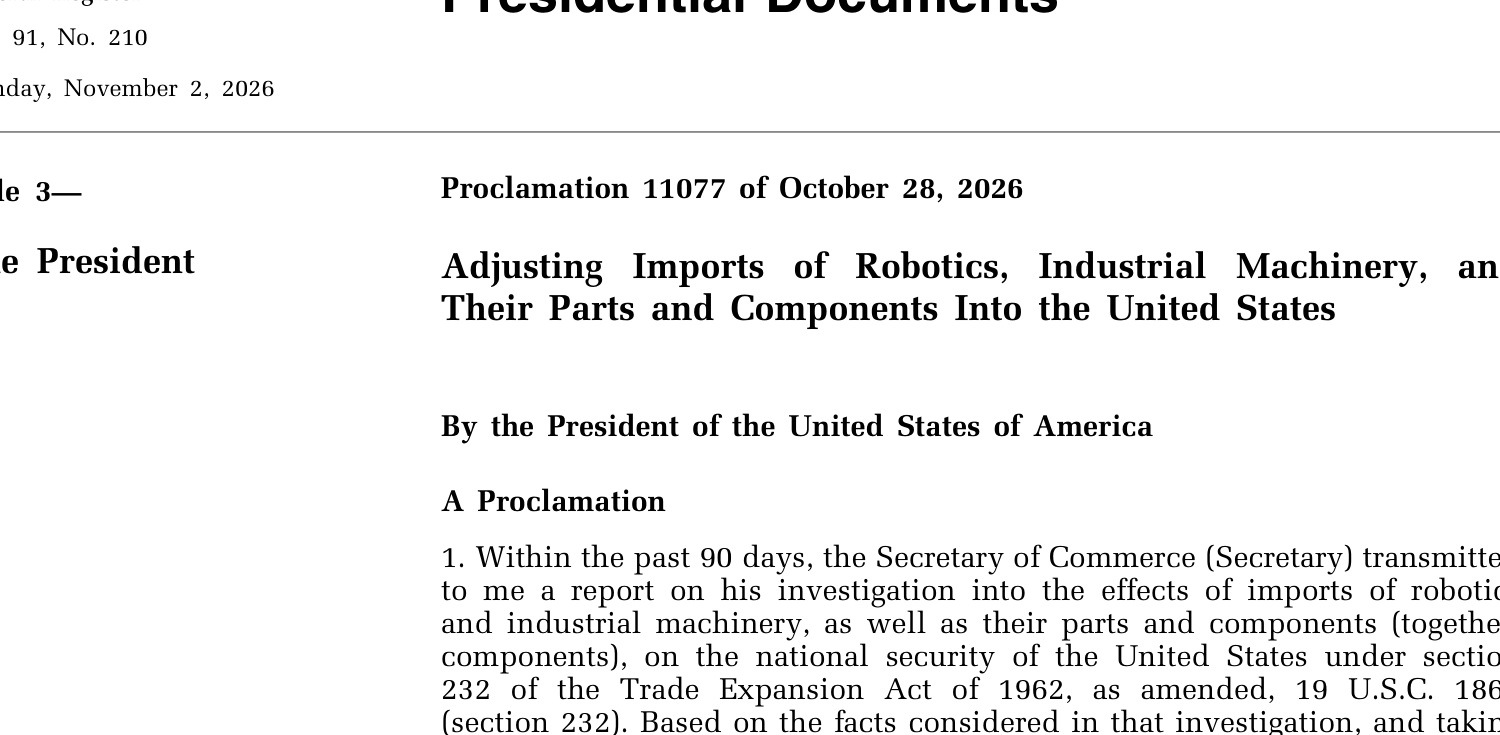
Proclamation 11077, signed October 28 and published in the Federal Register on November 2, directs the Secretary of Commerce and the U.S. Trade Representative to pursue or continue negotiations concerning imports of robotics, industrial machinery and their components. It calls for a progress update within 180 days and continued monitoring. The text identifies tariffs, duties, quotas and fees as possible future remedies. It does not itself set a new tariff rate or impose a general prohibition on importing robots. Read the primary source account.
The present action is a process change
The distinction between an active negotiation and an enacted charge is important for procurement. A buyer cannot calculate a new landed cost from a rate the proclamation does not specify. Nor should a supplier’s interpretation of possible future action be presented as a settled requirement.
The useful immediate response is better visibility into dependencies. Buyers can identify which components are critical to keeping a platform operating, what replacement arrangements exist and which contractual assumptions would be affected by a future rule. Those questions can improve planning without predicting the outcome of negotiations.
Service continuity extends beyond the purchase order
A robot’s country of final assembly is only one fact about its supply chain. Maintaining it can depend on sensors, actuators, communications equipment and software support sourced through different channels. Substituting a component may require requalification rather than a simple purchasing change.
That makes continuity and configuration control relevant to the same decision. An alternative part that is available quickly still has to work safely with the rest of the system. The proclamation does not establish that any particular vendor has an adequate substitute or that a particular deployment will be interrupted.
Follow the operative measure rather than a prediction
Future reporting should connect any claimed consequence to the text that actually creates it. A negotiation announcement, a proposed measure and an implemented requirement are different stages. The proclamation supplies a direction and a reporting interval; it does not allow readers to fill in the scope or rate of a later action that has not been specified.
That matters when vendors discuss possible cost or availability changes. A quotation may include assumptions about future conditions, but those assumptions remain commercial judgments unless supported by an operative rule. Coverage should identify the source of the assumption and avoid presenting it as a government decision. This preserves a useful distinction between planning under uncertainty and reporting an established obligation.
For deployed security systems, a supply interruption can affect different components on different schedules. Consumables, spare parts and a replacement platform do not necessarily have the same sourcing path. Understanding those distinctions can help an operator ask better continuity questions without making unsupported predictions about which products will be affected. The proclamation does not provide a vendor-by-vendor impact assessment.
The broader industrial question is whether subsequent measures change incentives to manufacture, source or support robotics equipment in particular locations. That could have consequences for availability and competition, but the direction and scale depend on the measures ultimately adopted and the response of suppliers. The current document establishes the process through which those questions may become concrete; it does not settle the answers in advance.
A progress report also should not be mistaken for the automatic start of a remedy. The document’s 180-day reporting interval is a milestone for information about the negotiations. Any subsequent action would need to be assessed on its own text, scope and timing. Preserving that distinction helps readers follow the policy process without converting a calendar date into an unsupported prediction. For now, the most reliable reporting will identify concrete agreements, official implementing measures and their stated applicability as they emerge, while treating commercial expectations about their effects as attributed judgments rather than established legal changes.
The near-term development is a formal negotiation and monitoring process with potential consequences for robotics supply. The larger effect will depend on subsequent agreements or measures and their actual scope. Until those are specified, careful coverage should distinguish policy direction from binding changes to a particular product’s import treatment, while keeping the operating life of deployed systems in view.
Source organizations: U.S. Department of Commerce, Office of the United States Trade Representative.
References
Questions, news tips or corrections? Contact [email protected].