Scaling drone operations also scales the administrative information needed to assess and supervise them. Applications, authorizations and supporting records have to remain usable while the people supplying that information can understand how it will be handled.
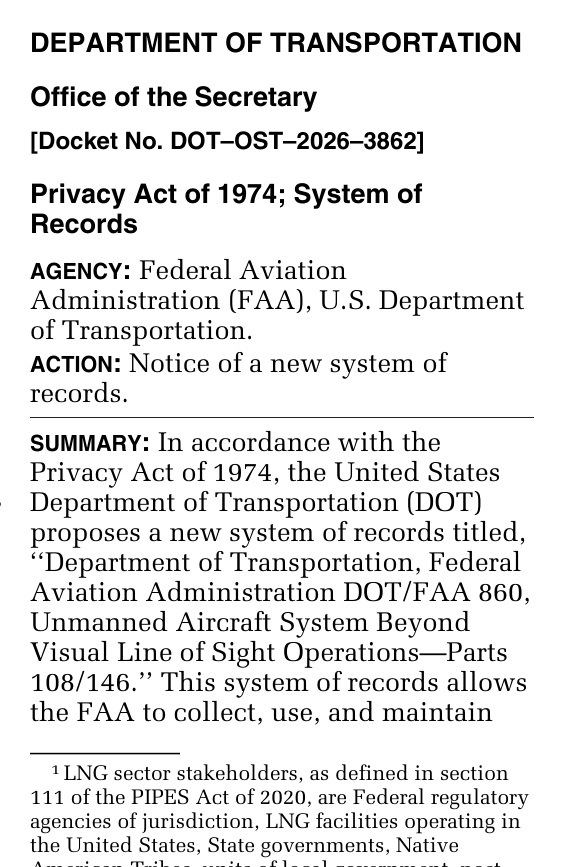
The Department of Transportation’s November 3 Federal Register notice establishes the FAA’s new DOT/FAA 860 system of records for unmanned-aircraft beyond-visual-line-of-sight operations associated with Parts 108 and 146. It covers information about individual operators, manufacturers and automated data-service providers requesting relevant authorizations. The notice specifies immediate effectiveness for the records system and a December 3 comment deadline and effective date for routine uses. This is a Privacy Act records notice, not a blanket flight authorization. Read the primary source account.
Administrative readiness is part of operational scale
A structured records system can support more consistent handling of applications and decisions. It also creates dependencies: applicants need to provide information in the expected form, and reviewers need to retrieve the correct record for the question they are considering. Those are practical operating concerns even though they are less visible than an aircraft demonstration.
The notice identifies retrieval fields including application and authorization identifiers. Consistent identifiers can help connect a decision to its supporting history. Their usefulness depends on accurate records and appropriate access, rather than on the presence of a database alone.
Disclosure and retention deserve separate attention
The listed routine uses describe circumstances in which information may be shared beyond the department. They should be read as specified disclosure provisions, rather than a promise that every record will be publicly available. The notice distinguishes some public waiver information from contact details and other authorization information.
It also states that the FAA is preparing retention schedules for submission to the National Archives and Records Administration and will treat the records as permanent until schedules are approved. That makes retention a concrete part of the system’s governance, rather than an unspecified future housekeeping issue.
Keep records governance separate from flight rules
A records notice and an operating authorization answer different questions. The former describes how an agency maintains information about individuals and the purposes and disclosures associated with it. The latter determines whether a particular activity meets the applicable operating requirements. The presence of an application in an administrative system does not establish that it has been approved.
That distinction should carry through an organization’s internal processes. The person responsible for preparing a submission needs to know which information is current and where its supporting evidence is kept. The person planning a flight needs the actual authorization and its conditions. A common identifier can help connect the records, but it cannot replace review of the underlying decision.
The comment process is also distinct from a permission to operate. Readers assessing the notice can examine the described categories of information, retrieval practices, safeguards and routine uses. Those are the subjects of this records action. They should not infer a change to an individual operation merely because the notice appears beside other drone-related regulatory developments.
Retention creates an additional implementation issue. If records are maintained for an extended period, their status and context need to remain understandable as applications and organizations change. A historical record can be important without representing current permission. Maintaining that distinction helps users interpret the record accurately and makes oversight more traceable, while leaving the legal effect of a particular authorization to its own terms and applicable rules.
The notice’s information categories can be read alongside an organization’s own record-keeping responsibilities. A submission may bring together information from an operator, a manufacturer and a service provider, but that does not make every contributor responsible for every claim. Clear provenance helps distinguish supplied facts from another party’s assessment. A practical administrative process would retain who provided an item and when it was checked. This is an implementation consideration arising from the records workflow, not a new requirement created by this article. The notice itself remains the source for its stated categories, purposes and disclosure provisions.
For drone-service organizations, the immediate relevance is understanding the administrative record around an operation and who is responsible for keeping submissions accurate. The larger benefit could be more traceable authorization and oversight as activity grows. That benefit depends on implementation and the substantive operating rules; the records notice alone cannot establish that a particular aircraft, route or service is authorized.
Source organizations: Federal Aviation Administration.
References
Questions, news tips or corrections? Contact [email protected].