A patrol robot moving through a trade-show demonstration can make an operating idea easier to understand. It cannot reproduce every interruption, obstacle and response responsibility at a working facility. The useful question is how the demonstrated functions map to a specific customer task. Indoor inspection and outdoor patrol share some software concepts, while presenting different access, surface and supervision problems. Treating them as one generic capability can hide the conditions that matter most to adoption.
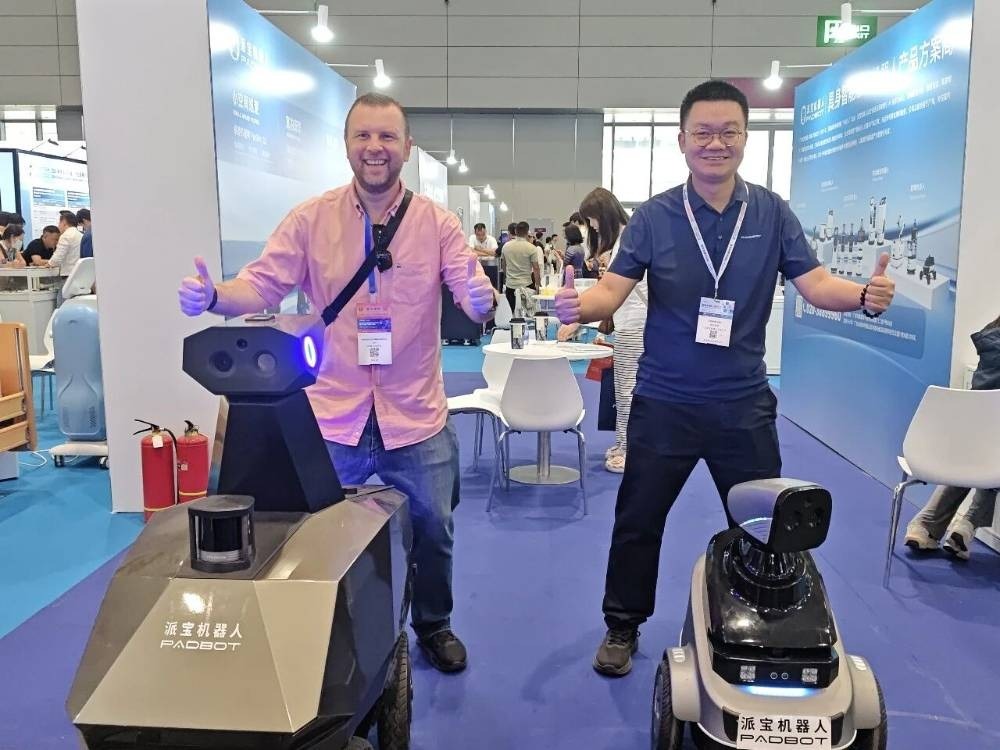
PadBot’s October 27 account of ROBOTECH 2026 in Shenzhen highlights the S2 indoor and S5 outdoor security patrol robots during the October 27–29 exhibition. The supplier describes scheduled routes, waypoint inspections, remote monitoring and alerts, with multi-floor navigation for S2 and outdoor environments for S5. It says detection categories depend on sensor configuration and can include smoke, abnormal temperature and excessive noise. This is a supplier exhibition account, not an independently measured deployment result. Read the original source account.
The route is part of the configuration
An indoor route can require interaction with lifts, doors and people using the same corridor. A capability described as multi-floor navigation should therefore be assessed through the actual transition between floors, not only the distance travelled on each one. The customer needs to know when the robot waits, requests assistance or changes its route. The public exhibition account does not provide the complete compatibility conditions for every building, so those details remain site-specific acceptance questions.
An outdoor route creates a different comparison. A wide industrial park, a commercial plaza and a transport facility do not present identical surfaces or traffic patterns. The S5 positioning identifies intended environments; it does not establish equal performance in all of them. A useful trial would preserve the selected route, the conditions encountered and the work transferred to a remote supervisor. That would make a successful result interpretable without converting one demonstration into a universal terrain claim.
A risk category is not a detection rate
The number of event categories tells a buyer something about the proposed sensor functions, but little about the reliability of an individual alert. An abnormal temperature indication needs a defined observation and threshold. A noise alert needs enough context to distinguish a relevant event from routine activity. Those dependencies should stay attached to the chosen configuration. Removing them would imply that every robot carries the same sensing package and performs every listed task equally.
A fair assessment should retain both missed events and alerts that did not require action. It should also record what the receiving operator could understand from the notification. A detection may be technically correct while remaining difficult to locate or interpret. Conversely, a clear alert can still arrive after the relevant activity has ended. These are evaluation dimensions suggested by the product’s intended use, rather than reported faults in the S2 or S5 systems.
Integration should preserve responsibility
PadBot describes compatibility with smart-building security systems. That can provide a route from a moving sensor to an existing response workflow, but the customer still needs to know who owns the next step. An alert displayed in two consoles should not leave each operator assuming that someone else has reviewed it. Integration testing should therefore examine acknowledgement, escalation and the record of the response, rather than ending when a notification first appears.
The exhibition also does not establish a staffing outcome. A robot may take over part of a repetitive route while creating preparation, supervision and recovery work elsewhere. Those changes can still be valuable if the complete arrangement improves the task. The comparison needs to count that work honestly. It should not infer labour savings from the existence of autonomous movement or from a supplier’s general claim that staff can focus on other duties.
A demonstration record should also distinguish a task chosen by the exhibitor from one specified by a prospective customer. Both can be informative, but they answer different questions. The first explains the intended behaviour; the second tests whether that behaviour fits the receiving site. Preserving that distinction would allow exhibition interest to become a disciplined evaluation rather than an unsupported assumption of readiness.
The immediate contribution is a visible product demonstration with distinct indoor and outdoor propositions. Its longer-term value depends on representative site trials that connect movement, sensing and human response. The next useful evidence would identify the tested configuration and describe both ordinary operation and interruptions. That would allow buyers to judge which parts of the exhibition account translate into dependable work at their own facilities.
Source organizations: PadBot Robotics.
References
Questions, news tips or corrections? Contact [email protected].