A security drone that flies a route successfully can still need human help before the next mission. The landing may be imperfect, the dock may be unavailable or the charging routine may not begin. Automating flight alone leaves those repeated jobs in the operating budget. FlytBase’s multi-vendor docking approach is useful to examine because the software coordinates the aircraft with a physical station whose state determines whether another mission can start.
Main contribution
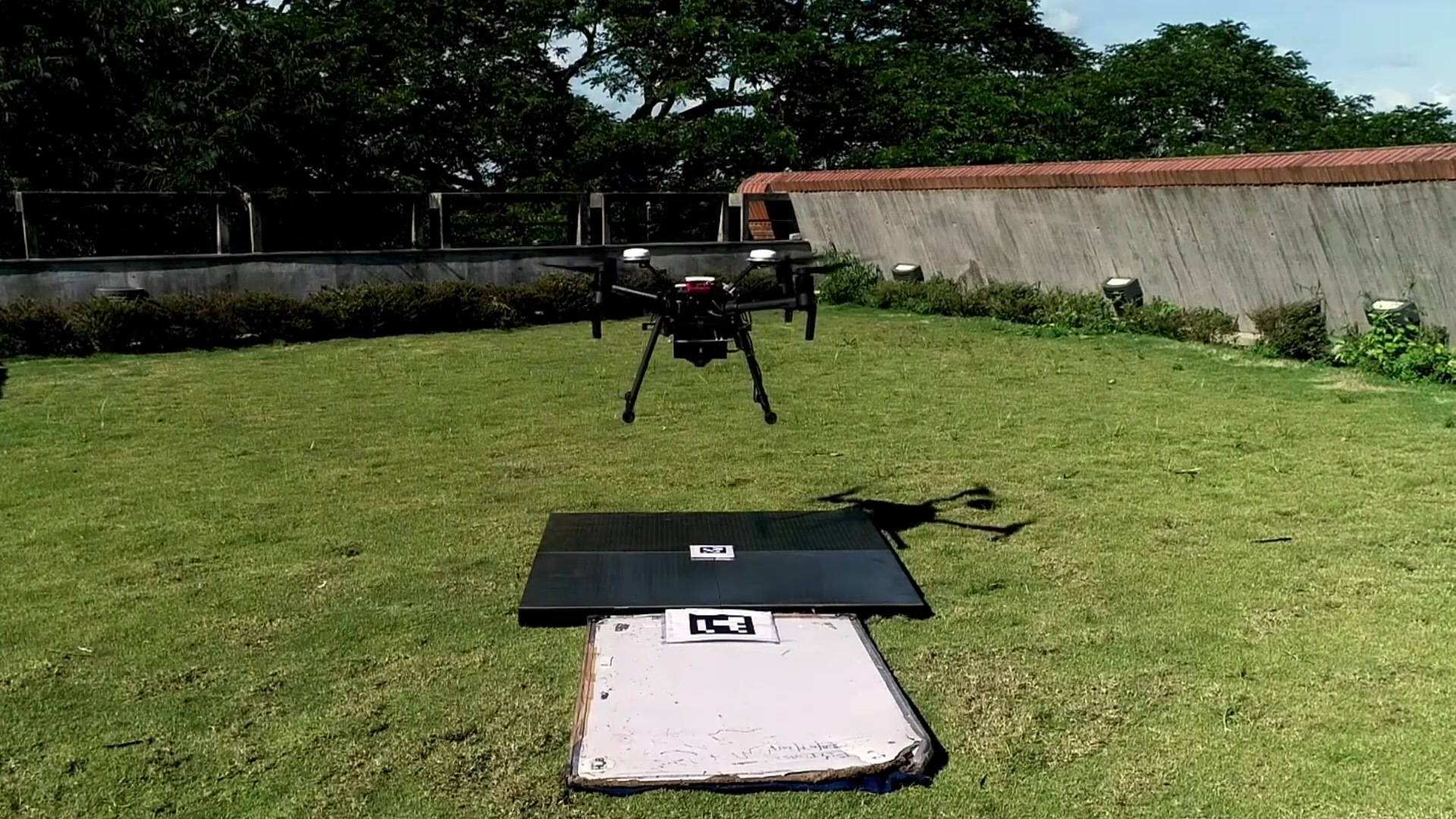
FlytBase coordinates supported drones and docks through an operating platform, connecting alarm-triggered missions, aircraft telemetry and the physical station’s state. The main contribution is orchestration of a repeatable response: a sensor identifies a location, an aircraft travels there, an operator receives the view and the system returns to readiness. Its dock settings make recovery behavior configurable, including return-to-home and return-to-safe-location. Landing verification is hardware-specific. This is a software layer operating physical aircraft, not a generic camera analytics story. The selected company demonstration below shows actual precision landing in an older hardware configuration. It illustrates the physical recovery problem; the current documentation establishes the dock-specific configuration discussed in the analysis.
Watch the system in action
FlytBase’s June2020 physical precision-landing demonstration. The older pictured aircraft and charging pad illustrate a recovery mechanism; they are not presented as the current complete product configuration. Watch the source video ↗
FlytBase describes an Edge Kit linking compatible aircraft and docking stations with cloud control and telemetry. Its dock-settings documentation distinguishes return-to-home and return-to-safe-location behavior, and notes that landing verification is supported only by certain docks. The system can keep a dock open after a detected incorrect landing in that configuration. These are documented capabilities and device-specific conditions, not a universal claim that every connected station performs identical readiness checks. FlytBase drone-in-a-box architecture. FlytBase dock settings and landing verification.
The completion condition belongs to the whole system
For a patrol, reaching the last waypoint is only one milestone. The aircraft must return to an appropriate location, the station must complete its supported post-landing routine and the operator must know whether the next flight is possible. A useful autonomous workflow defines those states explicitly. Otherwise a mission can appear finished on a map while the physical system still needs attention that nobody has been assigned to provide.
A dock that automatically closes around an incorrectly positioned aircraft could create a different problem from one that remains open and requests help. The documentation’s verification option illustrates why the specific hardware matters. Software compatibility means the platform can communicate with a device; it does not establish every mechanical or sensing capability the device possesses. Procurement should identify the offered station’s actual behavior rather than assume all docks inherit the richest documented feature.
Fallback is part of availability
The safe-location setting acknowledges that the usual dock may not be available. That is a useful operational boundary to plan, not an admission that autonomy has failed as a concept. A system is more dependable when it has a deliberate alternative than when it continues toward an unavailable target. The site must decide where the alternative is, what happens after landing and which coverage remains while the aircraft is there.
Imagine an illustrative perimeter mission returning to a station whose area is obstructed. The drone may complete a safe landing elsewhere while security staff still lose the immediate next patrol. A technically successful recovery and a fully available service are different outcomes. The report should preserve both, so a buyer can distinguish protected hardware from an interrupted observation function. That clarity makes the real reliability easier to improve.
Mixed hardware creates a configuration responsibility
Supporting several manufacturers can reduce dependence on a single device family. It also means different registration paths, settings and supported capabilities. A fleet manager should maintain a device-level configuration record instead of relying on one platform label. The useful operating promise is the set of qualified actions for each system, including how the software reports a function that is not available on that hardware.
A practical trial would repeat complete missions with the proposed dock, aircraft and network. Include incomplete landings, an unavailable station and a lost connection, then inspect recovery and the next ready state. Count interventions rather than only completed flights. This is a proposed evaluation. The product descriptions do not independently show the full-cycle failure rate or staffing requirement for the buyer’s particular collection of devices.
The economic gain may come from removing repetitive pre- and post-flight work more than from making the aircraft fly a faster route. Conversely, a low-volume installation may not recover the integration effort needed for a sophisticated multi-vendor workflow. The business case should follow mission demand and support effort, not assume that a broader compatibility list is itself a saving.
The recovery mode should explain the coverage result
A fallback landing can protect an aircraft while leaving the next patrol unavailable. That outcome should be visible to the security team in terms of missed observation, not only an aircraft status message. The operator needs to know which requested view was completed, which remains unresolved and what work would return the drone to its dock. A technically safe recovery is useful even when it does not meet every service objective.
Automatic docking also should not be confused with automatic incident judgement. The platform coordinates physical flight and station states according to supported settings; a security organization decides what evidence the mission needs and how to act on it. Keeping those responsibilities separate helps compare devices in a mixed fleet. One dock may verify a landing directly while another requires a different confirmation process. The important autonomy claim belongs to the specific supported sequence, with a named path for human assistance when that sequence cannot finish.
The wider consequence is to turn drones into managed physical infrastructure. FlytBase’s docking layer can help where the challenge is repeated useful missions rather than one impressive flight. Its value is a complete cycle whose state, exceptions and recovery remain understandable, so autonomy extends to readiness without concealing the human work that still supports it.
Deployment across sectors
A logistics operator could use a docked aircraft to inspect a distant fence alarm before a guard drives through an active vehicle yard. An energy operator could connect perimeter response with a qualified inspection mission, while keeping security events separate from maintenance work. A construction site could schedule aerial checks as its geometry changes. These are practical applications, not a claim that all named sectors have demonstrated the same deployment. FlytBase describes security, public-safety and industrial workflows; buyers should verify the actual dock, aircraft, network and permissions offered for their site. One vendor’s successful configuration does not automatically validate a different supported hardware pairing.
How it could change the world
If multi-vendor orchestration becomes reliable, customers may buy aerial coverage as an operational capability instead of building a specialist drone team for every property. The wider effect could be faster verification across large estates with less repeated manual preparation. Interoperability also creates accountability questions: who diagnoses a failed launch, a poor landing or missing evidence when several suppliers share the chain? The useful future is one in which the complete mission is observable, recoverable and repeatable. The drone can then become a practical extension of a response team, with the human decision about the incident remaining visible.
References
Questions, news tips or corrections? Contact [email protected].