A procurement team needs to know both whether a device can be supplied under applicable communications rules and whether it can perform its assigned work. Those are separate questions, even when both are described as approval.
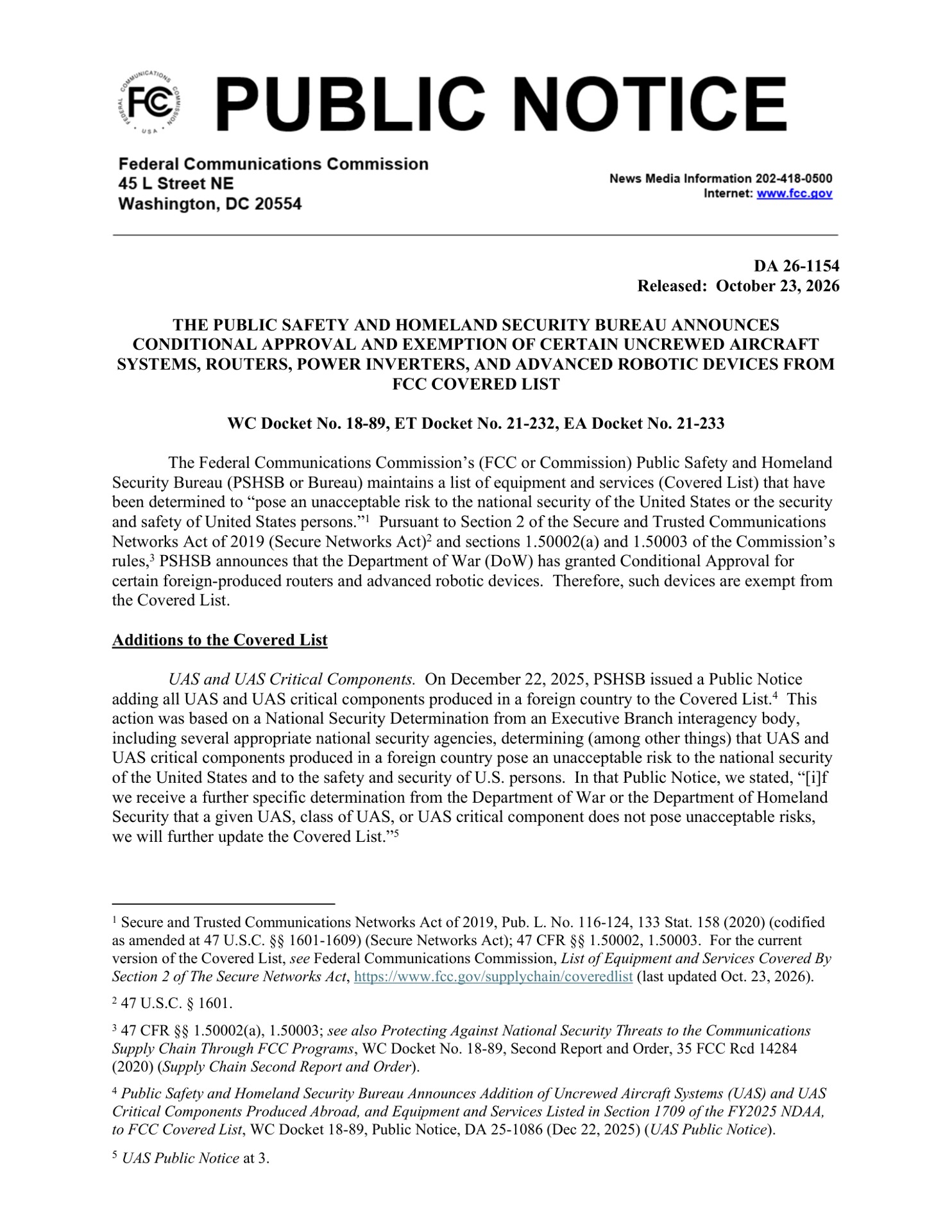
The FCC’s October 23 public notice DA 26-1154 records conditional approvals and Covered List exemptions for specified equipment. Its appendix includes Haystack Robotics’ Violet AI device and T-Robotics’ automated-guided-vehicle product class, alongside other equipment categories. The notice describes continuing conditions, including compliance with onshoring plans and updated vetting. This article reports the notice’s scope rather than determining eligibility for a particular purchase.
Match the record to the equipment
The relevant comparison is the named device or class, its configuration and the conditions attached to the determination. Extending an exemption to a different robot merely because it shares a manufacturer would discard that scope.
The notice is also not an operational test of navigation, detection or human interaction. Buyers still need separate evidence for their intended task and environment, with support arrangements and maintenance included.
Keep compliance evidence current
A procurement file should preserve the authoritative determination and enough product identification to show why it applies. If a configuration or supplier arrangement changes, the reasoning may need to be revisited rather than carried forward automatically.
The practical value of the notice is greater clarity about the named exemptions. Its limits are equally useful: regulatory status does not replace a deployment assessment, and a supplier’s broad marketing claim should not take the place of the underlying public record.
Original source and reported conditions.
Read the determination at the right level
The notice covers several categories of equipment, so a reader needs to identify the entry relevant to the device being considered. A determination about one router, aircraft or robot should not be generalized to another category. Even within robotics, a named device and an entire product class represent different scopes. The appendix is therefore part of the evidence, not administrative material that can be omitted from a purchasing summary.
The continuing conditions matter as much as the initial inclusion. The notice discusses compliance with the approved onshoring plan and updated vetting, and explains circumstances in which an approval can be revoked. A procurement file should retain that conditional character rather than reducing it to a permanent approved/not-approved label.
Market access and task suitability answer different questions
An exemption can remove a communications-regulatory obstacle while leaving the practical suitability of the robot untested. Navigation, interaction with people, operational availability and maintenance remain separate matters. A supplier should be able to provide the evidence relevant to those questions without using the regulatory notice as a substitute for performance data.
For example, a facility might establish that the documented product falls within the named class and still decide that it does not suit the intended route or support arrangement. That would not contradict the exemption. Conversely, a successful demonstration would not establish regulatory eligibility for a different configuration. Keeping the two decisions separate helps prevent a persuasive but incomplete sales presentation from joining them together.
Preserve the source as conditions evolve
The practical record should identify the notice, the relevant appendix entry and the product information used to match it. If the supplier later changes its manufacturing or component arrangement, the organization should revisit that match rather than assume that the original evidence applies indefinitely. This is a recordkeeping implication of a conditional determination, not a legal assessment of a specific transaction.
The October notice makes a public source available for checking supplier statements that were previously difficult to evaluate. Its contribution is clarity about the specified exemptions and their continuing conditions. For deployment teams, the next step is to combine that source with current product documentation and an independent assessment of the actual task. Neither regulatory status nor operational capability should be inferred from the other.
The public source also helps separate a current determination from an outdated summary. A vendor webpage may remain unchanged after conditions, product names or the applicable record evolve. Retaining a dated copy of the authoritative notice makes the basis of the decision inspectable later. That record should be paired with current checks when circumstances change, rather than treated as permanent proof. The resulting discipline is straightforward: identify the exact equipment, identify the exact determination and keep the operational assessment distinct from both.
References
Questions, news tips or corrections? Contact [email protected].