A docked drone can be unavailable for reasons other than an empty battery. It may be waiting for a safe launch, a communications check or a decision about the next task. Automating energy replacement can remove a significant delay, but the complete response cycle still needs to be measured from an actual request through a useful observation and return to readiness.
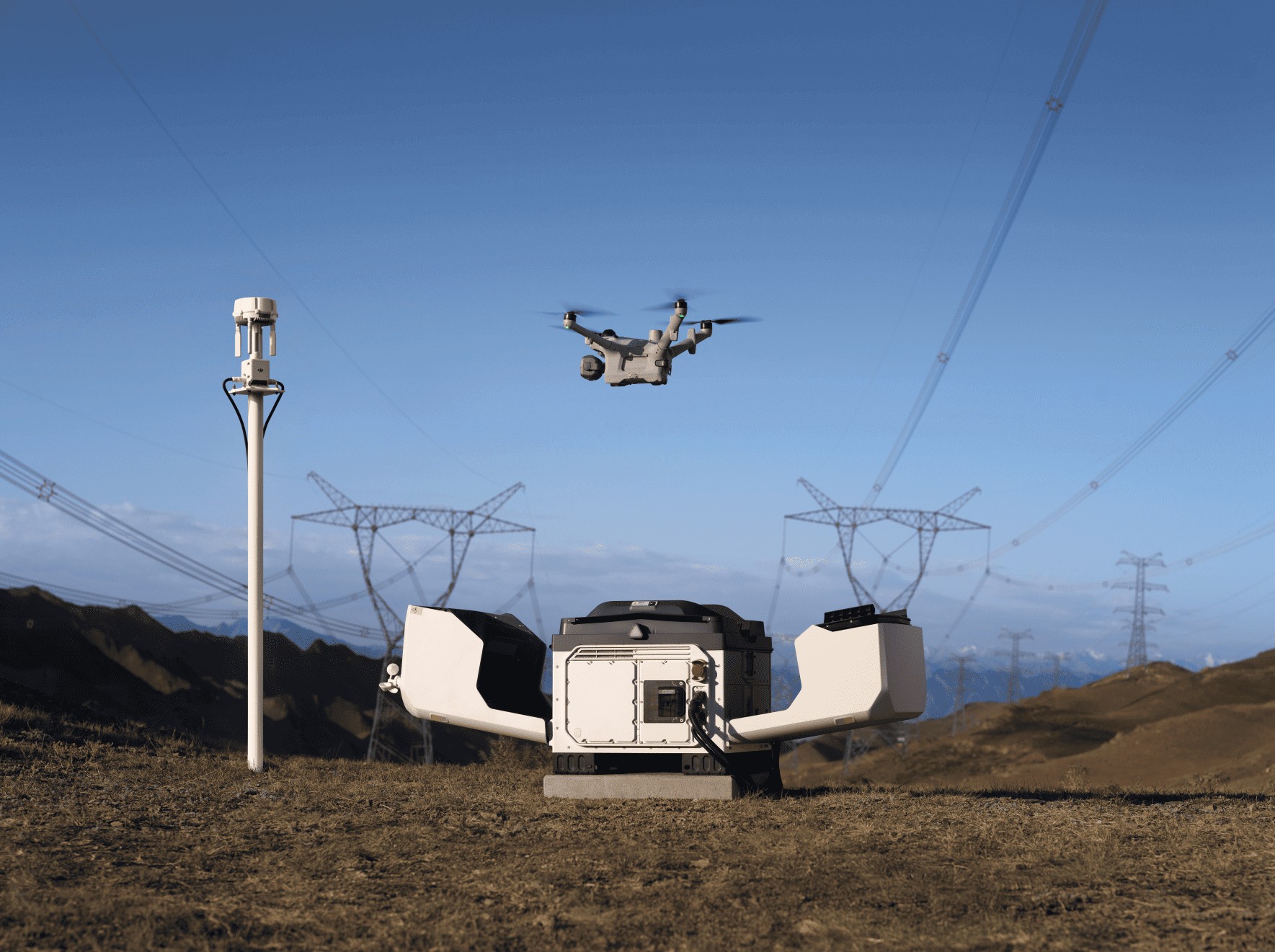
DJI’s October 14 release introduces Dock 4 with automatic battery swapping and the Matrice 5TD aircraft. The company claims a 25-second battery swap and up to 59 minutes of flight in its stated test conditions. It describes visible and thermal imaging, obstacle sensors and onboard object detection. These are manufacturer specifications and capabilities, not independently measured results for every proposed public-safety, overnight-security or inspection site. Read the primary source account.
Define where the turnaround measurement begins
The support specifications define battery-swap time from closure of the dock cover to completion of the swap. That boundary matters. It does not include every second between a returning aircraft’s arrival and a subsequent authorized takeoff. The launch describes rapid turnaround, but readers should preserve the measured interval instead of treating it as a universal end-to-end response time. A narrower result can be useful when it is not enlarged beyond what was measured.
An illustrative repeated-patrol evaluation would record flights, dock operations, charging state, health checks and periods when the system could not launch. This is a proposed evaluation, not a reported Dock 4 deployment. The relevant service measure is the availability of an appropriate aircraft when needed, with the reason for each unavailable period visible. A successful swap demonstrates one mechanism within that larger service and cannot establish all-day coverage by itself.
Communications also need the installed configuration attached. DJI states that Dock 4 requires its O4 Ground Station and provides network recommendations in the support material. A laboratory latency figure or maximum transfer rate does not guarantee the same result through a customer’s network. The operational team needs to test the complete path used for commands and observations, including how the interface represents delays and disconnections.
More sensors do not establish every detection outcome
The aircraft’s visible, thermal and ranging capabilities can support different observations, but their specifications answer different questions. Thermal output may help reveal a heat pattern while another sensor supplies visual context. A sensor list does not establish the probability of detecting every relevant event in every environment. The release does not provide an independent site-level false-alert and missed-event study for the full security workflow.
DJI’s stated onboard object categories similarly describe a feature boundary rather than an authorization to act on each detection. An alert should reach the person responsible for interpreting the event and deciding what response is appropriate. For an illustrative perimeter task, recognizing a vehicle is not the same as establishing that its presence is unauthorized. These are separate operational decisions, and no intent-recognition capability is inferred from the product announcement.
Environmental specifications must remain tied to their test conditions and to the distinction between dock and aircraft. A dock’s temperature range does not automatically prove every aircraft behavior at every point in that range. Maximum wind or flight-duration figures should not be combined into an untested worst-case mission. A customer can request the supported operating envelope for its actual payload, site and procedures without assuming that all listed maxima occur together.
Availability also varies by region and regulatory context. DJI’s own material qualifies features and operating frequencies by country and configuration. This article does not infer US procurement eligibility, a local flight authorization or permission for beyond-visual-line-of-sight operations from a global product launch. Those questions require the applicable records for the proposed location and operation, while the engineering specifications describe what the product is intended to support.
The support material also distinguishes dock and aircraft accessories. Any evaluation should identify the installed payload and firmware rather than assume results transfer unchanged across every compatible option. That record would make a later comparison reproducible.
The next useful evidence is a sustained, configured operating record that separates battery handling from complete mission readiness. Dock 4’s automated swap is a concrete mechanical development that could reduce one source of delay. Its broader security benefit depends on the aircraft, network, operator and permissions working together repeatedly, with unavailable periods and interventions reported alongside successful flights.
References
Questions, news tips or corrections? Contact [email protected].