A building can contain thousands of routine security questions after the working day ends: whether a door stayed open, whether somebody needs help, or whether an unusual condition deserves an inspection. Sending a person to every location consumes time even when nothing requires intervention. A mobile indoor robot offers another way to put attention where it is needed. The larger opportunity is a security service that can investigate without asking a guard to walk every ordinary circuit.
Main contribution
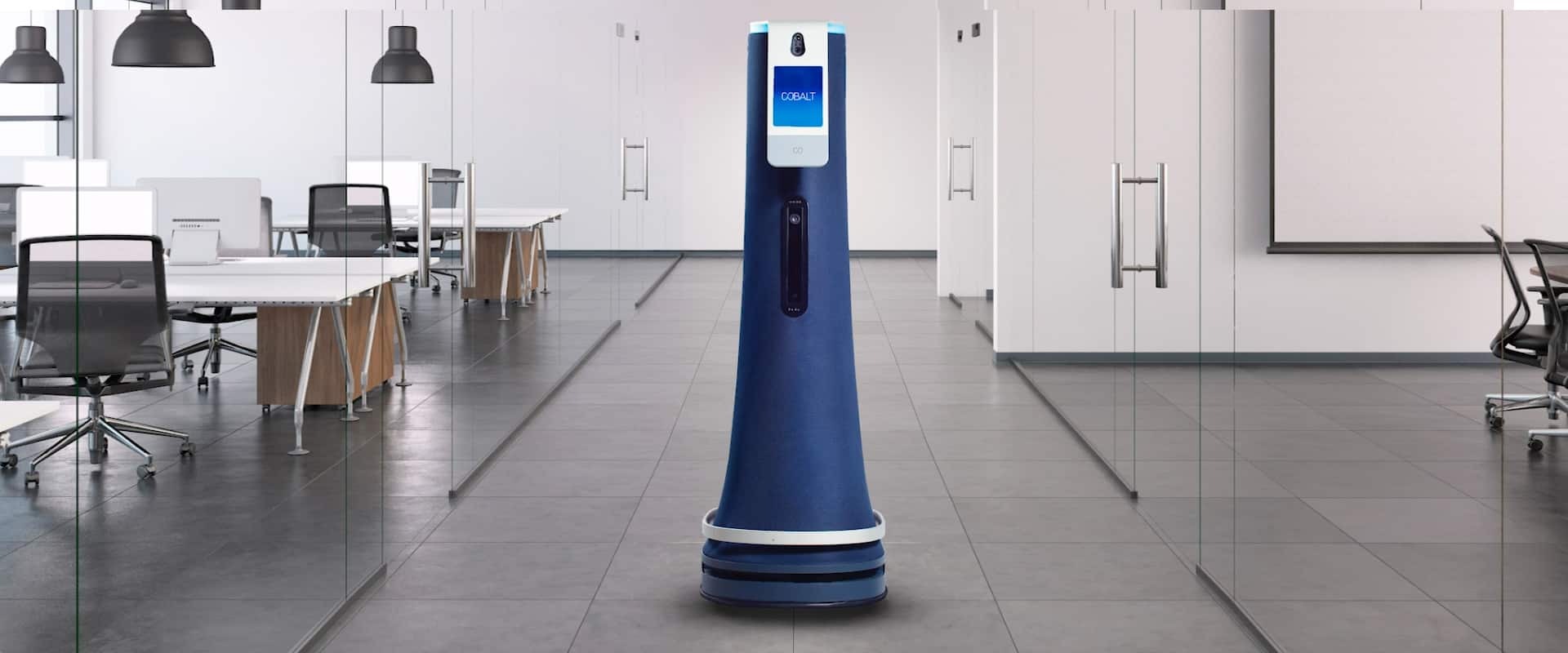
Cobalt combines an indoor mobile robot with onboard sensing, a monitoring platform and dedicated remote specialists. Its product page describes scheduled and requested patrols, event processing and two-way interaction. The contribution is the connection between physical movement and a staffed response service. The robot can take an observation point to the incident while a person remains available for context and communication. Those supplier descriptions establish the system's intended functions, rather than proving the outcome of every customer installation.
Watch the system in action
Official supplier demonstration of the moving security platform; footage illustrates operation rather than independently measured security outcomes. Watch the source video ↗
How moving observation changes the workflow
Mobility makes the location of a sensor a decision rather than a permanent installation choice. A robot can visit a corridor, inspect a doorway or provide a screen through which a remote specialist talks with somebody. That makes the route, travel time and access conditions part of the security service. An incident is not resolved simply because a mission command was issued; the machine needs to arrive, obtain useful evidence and report its actual state.
The supplier describes processing on the robot and event transmission to its platform. That approach may reduce the need to stream every ordinary moment, but a customer still needs to verify what is stored and transmitted under the purchased configuration. Cobalt's current page uses both event-only processing language and broader descriptions of information reaching the platform. The contract and configuration should settle that detail rather than an editor assuming one sentence defines every deployment.
The building is part of the autonomy system
A corridor robot needs more than a clear floor. It needs a route through the spaces relevant to the task, a way to handle temporary obstacles and a predictable response when a passage is unavailable. Building access can be a larger constraint than navigation. An Otis and Cobalt announcement describes an elevator integration that allows the service to work across floors. That is evidence of a specific integration approach, not permission to assume every lift or secure door is already compatible.
Consider an illustrative office where the important alarm occurs upstairs behind a restricted doorway. A robot that can navigate the lobby but cannot access that floor does not supply the intended inspection. A door integration or a human escort may solve the problem, but it belongs in the operating plan. Testing should include access failures, the queue for a lift and temporary changes to the route, alongside the appealing demonstration of ordinary corridor travel.
Applications across sectors
Corporate campuses are a natural intended setting because routes and after-hours checks repeat. A manufacturing building adds changing equipment, maintenance activity and areas where the robot needs a clear boundary from production traffic. Multi-building commercial property requires the service to know which person may authorize access and which team responds. These are application scenarios inferred from the operating model; they should not be presented as named deployments without customer evidence.
Cobalt's Otis announcement names General Motors and Slack as enterprises using its service at that time. That establishes an historical commercial context without revealing the present scale or claiming today's configuration is identical. Buyers in another sector should compare their own floor layout, access requirements and incident types. A robot suitable for office checks is not automatically qualified for clinical care, hazardous industrial zones or crowded public circulation.
Evidence that an investigation really helped
A useful trial measures completed inspections, useful observations and the staff effort remaining after automation. It should count failed arrivals and missions that required assistance. Two-way conversation also needs an authorized operator and a clear procedure for uncertainty. A remote specialist can ask a question or alert a local team; the robot's presence does not grant enforcement authority or supply all of the knowledge that an on-site employee possesses.
The economic comparison should include building preparation, connectivity, the managed service and recovery when the machine is unavailable. Saving repetitive walking could be valuable even when the same response staffing remains. A more demanding claim, such as removing a whole guard role, would require evidence about the duties beyond inspection. Separating those claims helps an organization buy a useful capability without silently changing the protection expected by people in the building.
How it could change the world
Indoor security could become less dependent on somebody being physically close to each routine question. A moving robot connected to a responsible operator makes remote attention tangible: it can travel, observe and enable a conversation. If that arrangement proves dependable, people could spend more time handling exceptions while ordinary checks become easier to document and repeat. The significant change is a service whose presence can move to where it is needed, with the boundaries of access, judgement and responsibility remaining visible.
Questions, news tips or corrections? Contact [email protected].