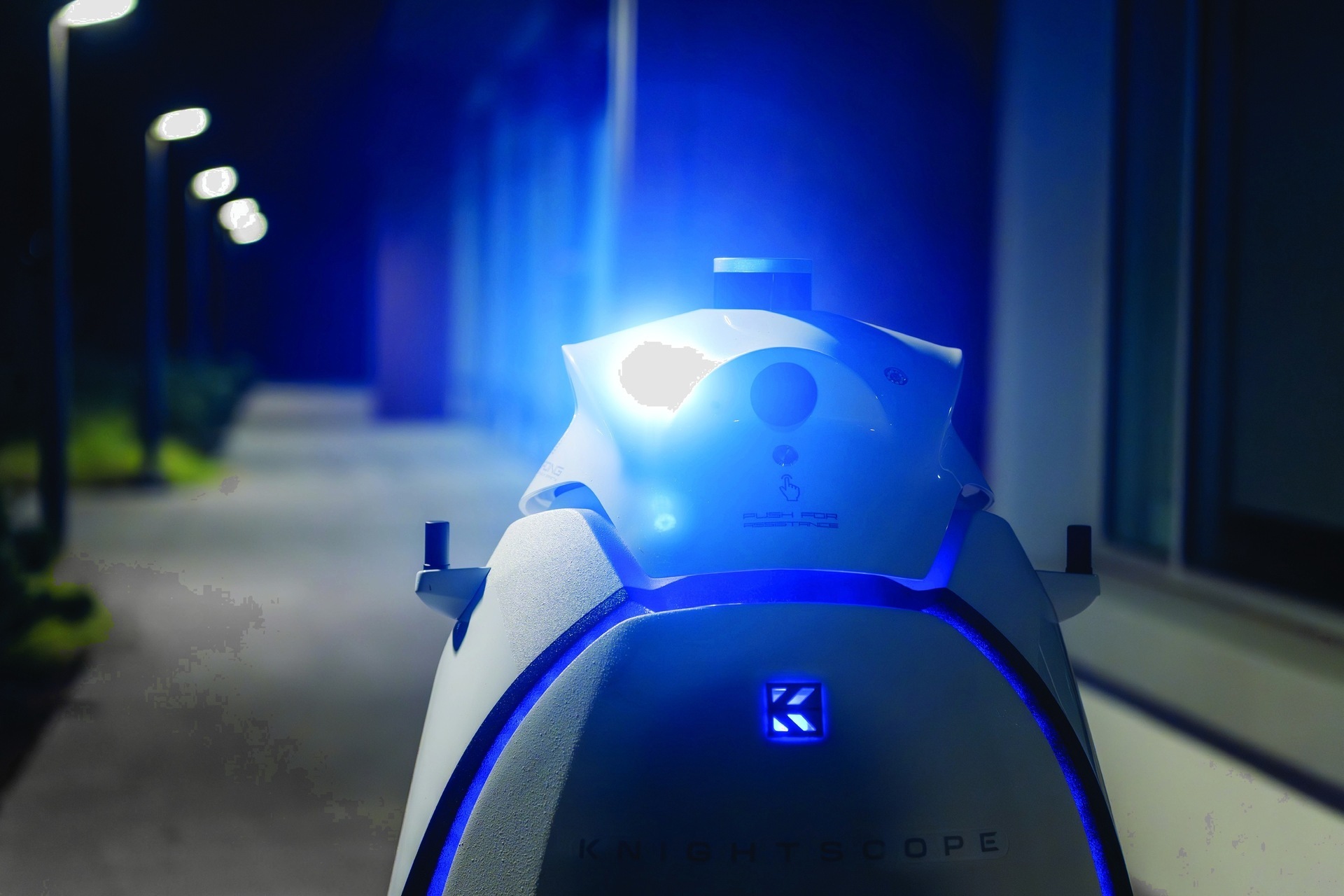
A patrol robot can repeatedly visit areas without demanding that a person walk every circuit. That is an attractive form of security automation, but the word continuous can blur several different promises. A service may operate continuously while a robot moves, pauses and charges in cycles. Knightscope’s K5 is useful to assess through that distinction: what protection remains when the mobile viewpoint is not at the location an incident occurs?
Main contribution
K5 turns a planned ground route into a repeatable mobile sensing and communication service. The contribution joins autonomous navigation and charging with a visible security presence; the resulting protection depends on where the platform is and who acts on its observations.
Watch the system in action
Official supplier demonstration of the moving security platform; footage illustrates operation rather than independently measured security outcomes. Watch the source video ↗
Knightscope’s brochure describes K5 cameras, thermal imaging, audio, navigation sensors and autonomous charging, with a stated average patrol period followed by charging time. Its current product material positions K5 for structured outdoor environments such as parking lots, campuses and walkways. These are manufacturer specifications and intended settings, not independent evidence that one unit continuously observes every part of a site or replaces the full job performed by a guard. Knightscope K5 product brochure. Knightscope current hardware scope and product status.
The route is the real operating area
A robot’s patrol boundary follows where it can travel reliably, where its sensors obtain useful evidence and how often it returns. A visible camera on a moving platform may capture an area well during a pass while leaving it unobserved between passes. That can still be valuable. It should be compared with the requirement for periodic presence or incident evidence rather than silently converted into a promise of uninterrupted surveillance.
The brochure’s surface and slope guidance makes the physical environment part of the device’s scope. A paved walkway and an irregular yard can require different platforms. The buyer should test gates, narrow passages and routes affected by parked vehicles or routine site changes. Successful autonomous navigation in a clear demonstration is evidence of a capability, not a qualification of every route through the customer’s property.
Charging is an observation gap to design around
Automatic return to a charger removes a repetitive human task. It also creates a period when the robot is not patrolling. The installation should define which areas remain covered by fixed sensors or another patrol during that period. The useful service measure is availability of the intended protection, not whether the robot completed its charge without assistance. Those can be different quantities even when the charging system works exactly as specified.
Imagine an illustrative parking structure where the most important event occurs near a remote stairwell. A robot that is charging or on another level may not supply timely visual confirmation. A fixed camera or a defined dispatch process could complement it. The customer should count that arrangement when comparing the service with an existing guard route. The robot can contribute mobility and presence without supplying every function that the original staffing pattern provided.
A sensor package needs an accountable response
The platform’s cameras, microphones and communication functions give staff information and ways to interact. They do not by themselves determine whether a detected condition deserves escalation or who physically responds. A deployment needs an explicit handoff from observation to authorized action. That is a system design requirement, not a criticism inferred from the product. Purchasing a mobile sensor also means deciding what the organization will do with its findings.
A trial should record completed routes, interventions, missed coverage and the quality of incident recordings. Include busy periods and ordinary obstructions, with the charger in its proposed location. Compare useful observations and remaining staff work rather than counting robot hours alone. A unit can accumulate operating time while repeatedly observing low-value areas. The evidence worth purchasing is the contribution to the site’s actual protection objectives.
The economic case may be strong where repetitive patrol and visible presence consume considerable human effort. A countercase is a site needing frequent discretionary interaction or access to terrain outside the stated navigation conditions. The scope should follow those requirements, without treating a robot’s existence as proof that a whole position can be removed.
Navigation autonomy does not replace a guard’s discretion
The machine can perform a bounded physical task by following a qualified route and restoring charge. The meaning of an observation is another matter. A person beside a vehicle might be a contractor, a driver seeking help or somebody entering without permission. Distinguishing those cases can require information outside the robot’s sensors. A deployment should state which alarms the robot generates, who checks them and which actions are automatic versus remotely directed.
That boundary is relevant to staffing comparisons. A robot may remove repetitive walking while retaining the work of reviewing footage, answering interactions and attending an obstructed machine. Counting each retained responsibility prevents navigation success from being described as complete guard replacement. The customer can then value the role the platform actually performs, such as repeatable presence on a paved route, alongside the response capability maintained elsewhere. The most useful autonomy record shows both the miles handled by the machine and the decisions that still required local human knowledge.
Applications across sectors
Campuses, commercial property and logistics facilities all contain repeatable ground routes, but they value different outcomes. A campus may prioritize accessible paths and assistance for visitors. A distribution yard needs safe separation from trucks and a clear path to a response team. Hospitality properties must preserve guest access and define when a remote interaction is appropriate. The sector changes the mission and the escalation criteria; the existence of a mobile robot does not make every deployment equivalent.
A sector trial should begin with the observation that staff actually need, then choose checkpoints, operating hours and a response owner. Record unavailable patrol periods and situations requiring remote steering. This produces an honest comparison with the existing service and prevents a supplier demonstration from becoming a claim about a customer site that has not been tested.
How it could change the world
The wider consequence is a more repeatable mobile observation layer. Knightscope’s K5 can be assessed as part of a security service whose movement and charging are intentionally planned. Dependable autonomy will make both its presence and its absences clear, so staff know when the robot can help and what protects the site when it cannot.
Questions, news tips or corrections? Contact [email protected].