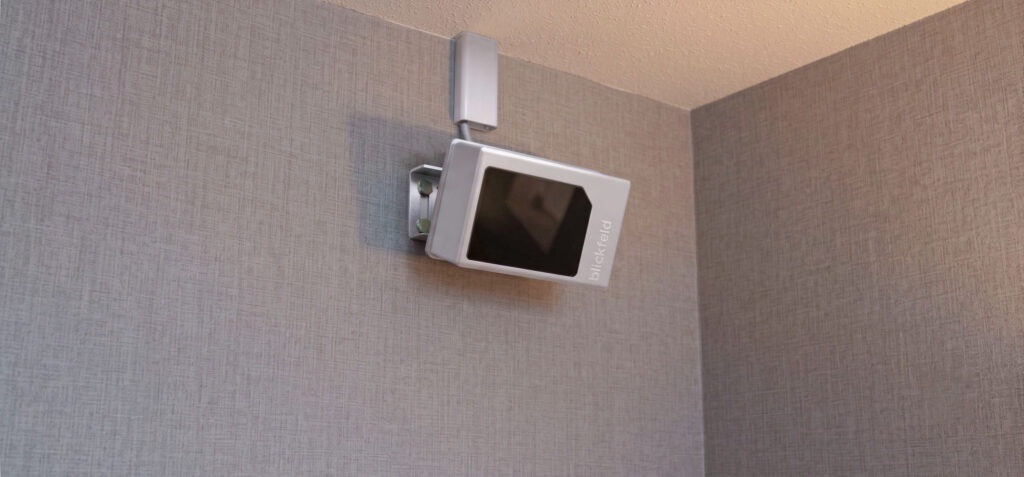
Protecting an artwork or a server rack requires a more specific observation than knowing that someone entered a room. A security team may care about a hand crossing a boundary, movement toward a protected object or the time spent inside a restricted volume. Those distinctions change both the sensor requirement and the meaning of an alert. A configurable three-dimensional zone can make the task more precise, provided the configuration matches what the receiving team actually needs to know.
Blickfeld’s September 14 introduction of QbProtect S describes a short-range indoor security LiDAR with on-device point-cloud processing. The supplier identifies museums, data centres, banks and other sensitive interiors as intended settings. It distinguishes applications up to thirty-five metres from reach-through detection claims up to twenty-five metres. Those figures describe different tasks and remain supplier claims. The announcement does not establish one universal detection distance or an independent performance result across every installation. Read the original source account.
Define the boundary before adjusting the alarm
A three-dimensional security zone can be tied to the space around a protected object, rather than to an entire camera image. Its practical value depends on selecting the boundary carefully. A zone that intersects routine permitted activity may create work for operators without improving protection. A zone that omits the relevant approach can miss the intended event even if the sensor measures its surroundings accurately. Configuration therefore belongs in the acceptance record alongside the device specification.
Blickfeld describes parameters including object size, direction, dwell time and track length. These settings offer ways to express the difference between ordinary movement and a condition requiring attention. They also create dependencies. Changing a threshold can alter which events reach the operator. A useful evaluation should preserve the selected values and the situations used to assess them, so a later adjustment can be compared with a known baseline rather than judged from a quiet display alone.
Spatial data changes the privacy question
The supplier emphasizes spatial mapping without ordinary facial imagery. That can reduce particular forms of visual identification, but it does not settle every question about the complete deployment. A system may combine spatial observations with other records, and people still need to understand how information is retained and used. The relevant assessment should describe the actual data path. A privacy-oriented sensor design and an organization’s overall handling of its observations are related, but distinct, matters.
For the same reason, the article does not adopt the supplier’s broad compliance language as a universal legal conclusion. A buyer needs to consider its purpose, integrations and operating arrangements. The product announcement supports an account of the proposed sensing approach, not a finding about every customer’s obligations. Keeping that distinction visible makes the technical benefit easier to discuss precisely, without converting a data-format choice into a blanket assurance about a whole facility.
Measure the operator’s task
An on-device alarm can reduce the need to transmit a full raw data stream for every decision, while leaving the receiving operator dependent on a useful explanation. The alert should convey which zone and condition triggered it and what supporting context is available. A technically valid event can still be difficult to act on if it arrives without enough information. The acceptance task is therefore the complete sequence from observed movement to an appropriate human response.
A realistic comparison should include permitted activity near the protected object as well as deliberate boundary crossings. It should examine whether configuration changes reduce unnecessary alerts without hiding relevant events. The public introduction does not provide a universal false-alarm or missed-event rate. Those measurements would make the supplier’s practical claims more inspectable, especially in settings where operators already receive information from several security systems and must prioritize their attention.
A protected object can move during normal operations, so configuration ownership should be explicit. Museum staff may change a display, or a data-centre team may alter rack access. The security team needs to know when those changes require revisiting the zone. Otherwise, an accurately measured boundary can become misaligned with the task it was intended to support. That is a maintenance responsibility for the complete installation.
The near-term change is a dedicated indoor option within Blickfeld’s security portfolio, with the protected volume and alarm logic made explicit. Its longer-term significance depends on matching that spatial precision to an understandable response process. Evidence from defined customer tasks would connect the sensor proposition to a stronger operational case. Until then, the relevant achievement is the offered configuration, while dependable protection remains an outcome to assess in the complete environment.
Source organizations: Blickfeld.
References
Questions, news tips or corrections? Contact [email protected].