A closed door can divide an otherwise navigable inspection route. Simply leaving it open may undermine the reason the door exists, while placing a robot on each side changes the economics and support arrangement. Extending robotic access therefore requires more than a new navigation skill. The machine must interact with the facility’s existing permission and door systems without treating the ability to walk through as authority to enter.
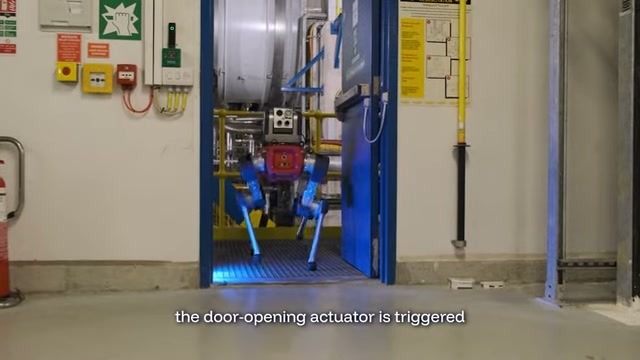
ANYbotics’ September 24 account describes door automation developed with dormakaba and an access-controlled configuration using LEGIC credentials. Its Whitegate Power Station pilot in Ireland automated two doors, including an entrance to an electrical room. The robot requests access, the site system checks permission and the actuator opens the door after approval; ANYmal checks the passage before proceeding. These are partner-reported pilot results, not an independent fleet-wide reliability measurement or proof of compatibility with every industrial door. Read the original source account.
Watch the system in action
LEGIC’s September 17,2026 source film explains the credential and automated-door interaction. The selected cover is at01:36. Supplier demonstration and interviews, not a new October deployment or independent reliability test. Watch the source video ↗
Permission precedes passage
The access decision is a meaningful part of the architecture. It keeps the question of whether a robot may enter separate from the question of whether its route requires entry. That distinction allows a facility to retain control over particular spaces. A robot can have a valid inspection assignment while lacking permission for one doorway. A useful operating record should make that outcome understandable rather than treating every incomplete route as a navigation failure.
The reverse distinction matters too. A granted access request does not itself prove that the opening is clear for movement. The system still needs to connect the authorization, the physical door state and the robot’s assessment of the passage. Those are successive conditions with different evidence. The supplier account describes the intended sequence, while a site acceptance exercise should examine how the configured arrangement handles ordinary changes and interruptions at each transition.
The door remains part of the facility
A door may serve security and other operational purposes beyond the robot’s immediate task. Automation should therefore be assessed as part of that existing environment. The relevant question is whether the complete interaction preserves the required behaviour before, during and after passage. Observing a robot enter once does not establish every condition under which the door must operate. The Whitegate pilot provides a concrete example, with a limited number of doors and a named industrial setting.
The public account does not establish that a particular ANYmal X configuration was used at Whitegate, and this article does not infer one from separate delivery announcements. Model identity, sensor configuration and access integration should remain traceable in their own records. Combining claims from different product milestones can make an apparent capability broader than any single source supports. The pilot’s value is clearer when it is assessed on the configuration actually described.
Availability has more than one stage
ANYbotics distinguishes door passage without access control, described as available now, from access-controlled configurations available on request with full rollout planned for 2027. That difference matters to a buyer deciding what can be deployed through an ordinary product path and what still requires a specific arrangement. A roadmap is useful information, but it should not be presented as evidence that every proposed integration has already reached general availability.
A customer evaluating the requested configuration should retain the supported doors, access-management environment and procedure when entry is denied. It should also examine what the robot reports when the planned route cannot continue. A clear exception can be more useful than an incomplete mission that leaves staff uncertain about which observations were missed. The public pilot account does not supply a universal comparison of inspection labour or availability, so those benefits require separate local evidence.
Credential changes are part of the same operating record. When a robot is reassigned or unavailable, the facility should understand which access permissions remain relevant and who manages them. The value of using existing access infrastructure is clearer when those lifecycle decisions stay connected to normal site administration. The pilot announcement describes the technical interaction; it does not disclose every customer’s future permission-management procedure.
The near-term contribution is a demonstrated connection between an inspection robot and existing industrial access infrastructure. The wider implication is that physical autonomy can expand by negotiating established boundaries rather than removing them. That case becomes stronger when permission, safe passage and completed inspection remain separately inspectable. Whitegate offers an example to examine; broader adoption depends on repeating the interaction across the doors, operating rules and interruptions that matter at each receiving site.
Source organizations: ANYbotics, dormakaba, LEGIC, GE Vernova.
References
Questions, news tips or corrections? Contact [email protected].