A security or inspection drone may have a legitimate task while still needing to account for restrictions along its proposed route. That makes the source of airspace information part of the operating workflow. A policy announcement can explain why a restriction exists, while a map can help a planner understand its approximate location. Neither should be mistaken for the complete conditions governing a specific flight at a specific time.
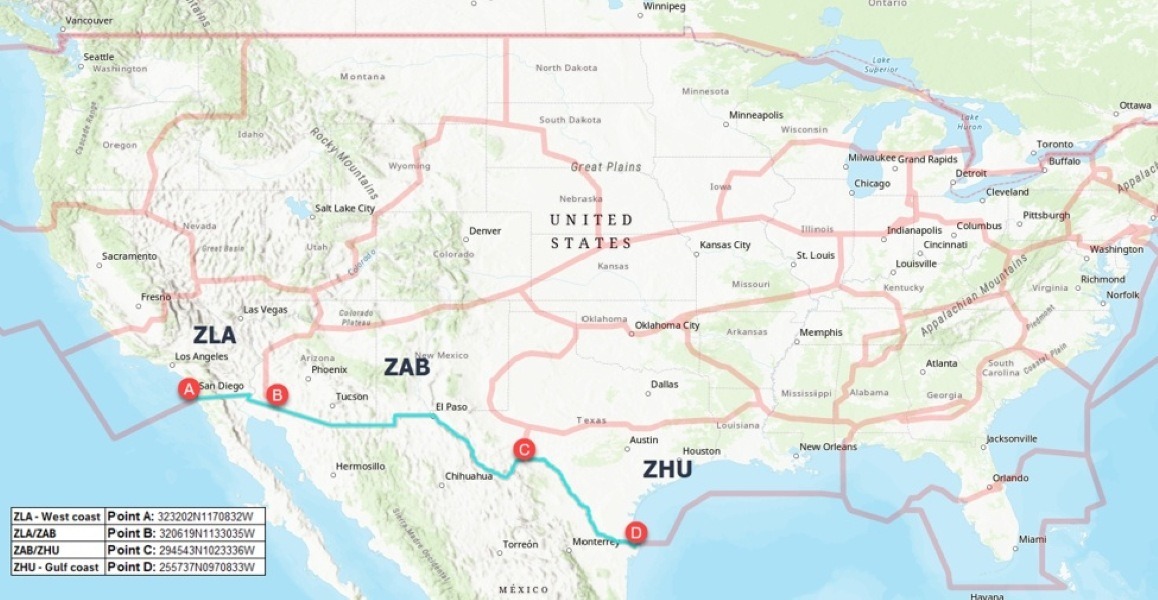
DOT’s October 16 announcement describes a southern-border drone restriction, including an area one nautical mile north of the U.S.–Mexico border from the surface through four hundred feet above ground. The FAA Domestic Notice separately carries an October 19, 2026–October 19, 2027 heading and identifies NOTAMs ZLA 6/9954, ZAB 6/9978 and ZHU 6/9956. It labels its graphic as situational awareness material and directs operators to the published NOTAMs for complete dates, boundaries, exceptions and operating requirements. Read the original source account.
Preserve the purpose of each source
The dates in the announcement and the notice should remain attached to their respective documents. Combining them into an invented single effective period would hide the difference between a policy communication and the operational details it references. This article reports those dated sources and does not certify the status of a proposed flight. The FAA’s instruction to consult the published NOTAMs is material to the story, rather than a footnote to discard when shortening it.
The same applies to the map. A consolidated graphic can communicate the broad geography more clearly than a list of notice identifiers. Its visual convenience does not make it a route-clearance tool. A planner needs the current authoritative details that correspond to the actual location and timing of the operation. The distinction is particularly important for automated mission systems, where a stored visual or summary may remain in use after its underlying source has changed.
A legitimate mission still needs coordination
The FAA notice describes a process for access requests and separate coordination for emergency or time-sensitive operations. The existence of those processes should not be read as automatic approval for every request. A team needs to preserve the difference between having submitted information and having received the applicable authorization. An internal mission plan should make that state understandable to the person responsible for launch, rather than relying on an assumption passed between planning and field staff.
This is relevant to security patrol, infrastructure inspection and other civilian services that may otherwise operate routinely. A repeated route can become familiar enough that the team stops treating its airspace assumptions as inputs requiring review. The policy development is a reminder that mission legitimacy and permission for the route are separate records. The article does not identify any particular company as noncompliant or suggest that all operations outside the described area are unrestricted.
Updates need to reach the operating team
An organization’s useful capability includes how it receives and applies changing restrictions. If the planning team checks a notice but the field team uses an older mission package, the information has not completed its handoff. A clear process should retain which authoritative material was checked and how a relevant change reaches the people executing the task. This is an operating consideration, not evidence that a particular operator has made such an error.
A local map or automated route tool can support that process if its limitations remain visible. It should not silently convert a summary into a guarantee that a mission may proceed. When uncertainty remains, the responsible team needs a defined path for resolving it before launch. The FAA notice’s reference to published NOTAM details provides the relevant source hierarchy; the practical work is ensuring that hierarchy survives the transfer into a customer’s daily planning workflow.
For organizations serving several customers, the same update should reach scheduling and customer communication as well as the pilot. A route that requires additional coordination may change when a service can be performed. Keeping that dependency visible avoids promising an inspection time before the relevant operating conditions are resolved. This is a planning implication of the notice structure, rather than a prediction about any particular access request.
The immediate significance is an announced restriction and a related FAA notice that identify where operators must look for the complete conditions. Its wider impact is to make authoritative information handling part of dependable drone service. Better autonomy cannot compensate for a planning record detached from the applicable airspace requirements. The useful outcome is a traceable connection from current notices to an authorized operating decision, with the policy explanation, graphic and controlling details kept in their proper roles.
FAA Domestic Notice and references to the operative NOTAMs.
Source organizations: U.S. Department of Transportation, Federal Aviation Administration.
References
Questions, news tips or corrections? Contact [email protected].