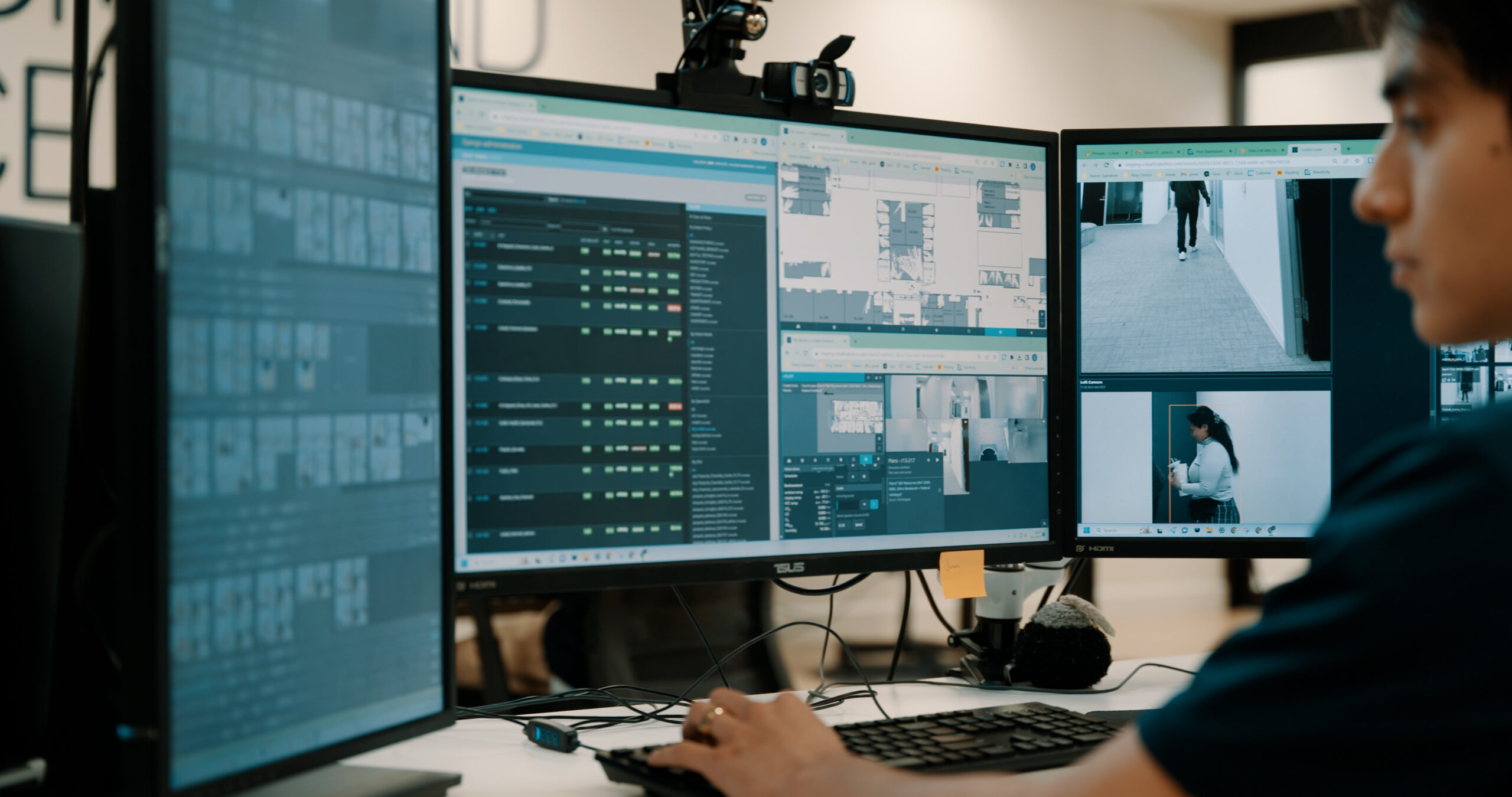
Putting a robot into a facility requires more than a capable model. Communications, remote supervision, data handling and integration with the organization’s work determine whether the machine can be operated responsibly over time.
KDDI and ELYZA’s October 27 Japanese-language release announces ELYZA Robotics, which began business on October 1. The group plans thirty-billion yen of research investment and more than 300 specialists through fiscal 2030, targeting more than 1,000 robots in real settings. The stated applications include retail, logistics, manufacturing and services. These are organizational commitments and targets, not evidence of a thousand deployed machines or a validated security-patrol product.
Research and operations must meet at a defined task
The proposed operating platform includes distributed inference, remote monitoring and coordination of multiple robots. Those capabilities can support facility automation, but each deployment still needs a precise statement of what the machine is allowed to do and when a person must intervene.
A demonstration of one task cannot establish suitability for every site in a broad commercial roadmap. Acceptance should preserve the environment, permitted actions and support arrangements that made the result possible.
Treat the deployment target as a future milestone
The near-term evidence will come from identified pilots, reproducible tasks and the handling of exceptions. Counting installed hardware without considering usable work and maintenance would give an incomplete account of progress.
The plan is relevant to the infrastructure behind physical AI. Its eventual contribution to safer facility operations will depend on the operating record of specific applications, rather than the size of the research commitment alone.
Original source and reported conditions.
The organization is a platform for future work
Creating a specialist company can bring research and deployment responsibilities into a common structure. That may help coordinate priorities, but the structure itself does not demonstrate a robot’s capability. The relevant evidence will come from the tasks selected, the systems built around them and the results of operation in the intended environments.
The release’s long-term targets should therefore remain visibly conditional. A planned number of robots is not an installed base, and an investment plan is not a measure of useful work. Those targets provide a direction against which later progress can be compared. They should not be used to imply that the company has already delivered the final scale.
Field data needs a defined purpose
The announcement connects field experience with research and model development. That feedback can be useful when the data preserves the context needed to understand success and failure. A record of movement without the task definition may be less useful than a smaller set of well-described attempts. The same principle applies to human interventions: they are evidence about the operating system, not merely examples to remove from a success rate.
For facility operators, data collection also needs clear ownership and access rules. A robot may observe people, equipment and business processes in the same scene. Decisions about what to retain and who may use it should be connected to the stated task. The release does not provide a complete policy for every future deployment, so those details remain part of local implementation rather than assumed features of the platform.
Coordination creates an additional test boundary
Multiple robots can share information while still requiring a clear allocation of work and authority. A system should make it possible to distinguish an assigned task, an acknowledged task and completed work. Without those states, a shared interface can create the impression of coordination while leaving uncertainty about which machine is responsible.
The near-term opportunity is to build that operational discipline alongside the research program. Evidence from identified pilots would help readers assess whether the new organization is translating model capability into dependable services. For security and facility teams, the transferable lesson is to evaluate the operating infrastructure with the robot rather than after it. Remote supervision, data handling and support are part of the deployed capability, even when the most visible announcement concerns the AI.
A useful pilot would also state its stopping conditions. An automated task should have a defined boundary when the environment, equipment or available information no longer supports safe completion. Recording these boundaries can be more informative than showing only successful runs. It tells the receiving organization what supervision and backup remain necessary. If the new company makes this operational evidence available as its pilots develop, readers will be able to assess progress against the stated ambitions without confusing an expanding research program with a finished, generally deployable robotic service.
References
Questions, news tips or corrections? Contact [email protected].