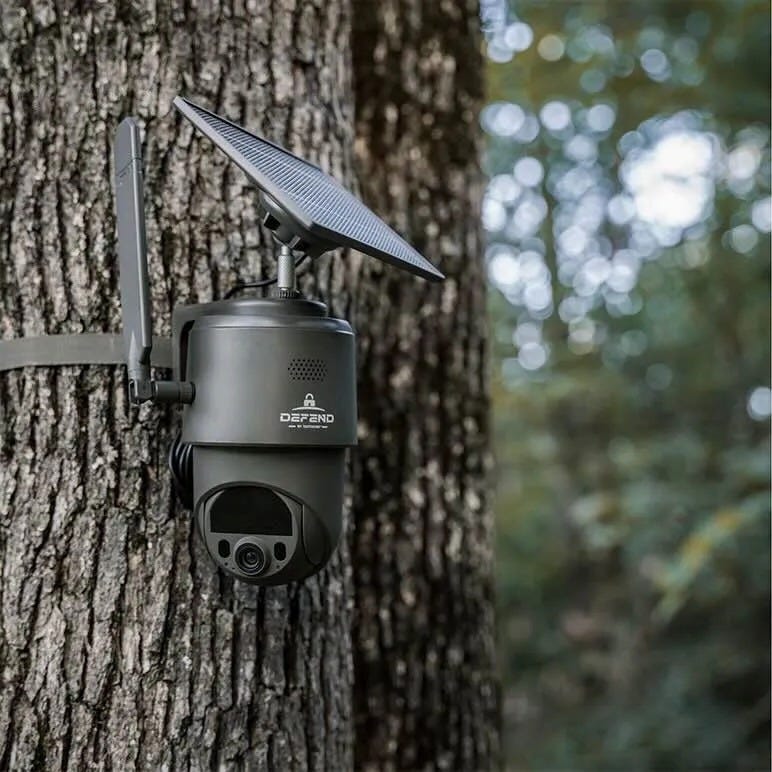
Tactacam's sale to GTCR closed on September 28 with more than one million subscribers across its platform, according to the announcement. That number covers the company's business, including its outdoor-camera roots; it is not a count of commercial security customers. The distinction is central to understanding what GTCR bought. September 28 transaction announcement
The strategic opportunity is an established route for delivering connected cameras and subscriptions to people who need to see remote places. Tactacam's Defend line extends that model into property security. Our analysis is that distribution and recurring connectivity may bring autonomy to a much larger perimeter before sophisticated response automation becomes standard.
The boundary used to be the network cable
A remote gate, temporary job site or outbuilding can be difficult to cover with conventional connected security equipment. Installation work and network access can dominate the decision. Cellular cameras change the first question from how to connect the location to whether the location has adequate coverage and an affordable operating model.
The transaction announcement describes Defend as a 2024 extension of Tactacam's cellular platform into residential and commercial monitoring beyond ordinary Wi-Fi reach. GTCR says it will support product development and wider distribution. The price and other financial terms were not disclosed, so the announcement cannot support a valuation comparison or an estimate of acquisition returns. September 28 transaction announcement
A wildlife-camera business carries useful infrastructure
Selling connected outdoor cameras can build capabilities that matter in adjacent security markets: device onboarding, remote image delivery, subscription administration and support for equipment outside a building's network. These are not the same as alarm response, but they reduce friction in putting an observation point somewhere new.
Bertram Capital's September 30 exit announcement emphasizes this extension from Reveal into Defend. It provides the seller's account of the transaction, not independent validation of future demand. Still, the buyer and seller descriptions agree on the underlying adjacency: an existing cellular platform being applied to property monitoring. Bertram Capital's September 30 exit announcement
The interesting autonomy pathway begins with coverage. A previously unseen location can become observable. Event detection may then help decide which images deserve attention. Only after that does the question of intervention arise. Compressing those steps into one claim that a connected camera autonomously protects a site would hide the unfinished work.
The subscriber is not necessarily buying response
A user who wants to inspect a remote image has a different expectation from a business buying a monitored security service. The latter may need defined response times, verified alarms, multiple user roles and an escalation route when the owner cannot answer. A camera subscription does not establish that those functions are included.
Tactacam's Defend 360 materials make the product direction concrete, describing a camera aimed at property monitoring. Product recognition and feature descriptions help establish market positioning; they do not prove that customers experience fewer losses or that the system can replace a staffed response. Those outcomes require deployment evidence. Tactacam's Defend 360 product account
This creates room for integrators and monitoring providers. They can build an operating service around inexpensive, widely available observation points. It can also create a difficult boundary: who is accountable when an alert reaches a phone but nobody acts? The answer belongs in the service offering, rather than being assumed from the presence of a camera.
Capital can accelerate reach before capability
GTCR's portfolio includes other security and subscription businesses, a context noted in the transaction release and subsequent trade coverage. That experience may help distribution, but it does not establish a product integration or a plan to combine customers across companies. Common ownership is not a technical roadmap. September 28 transaction announcementSecurityInfoWatch's transaction coverage
The immediate impact to watch is therefore commercial execution: which channels carry Defend, which customer types adopt it and what services surround it. A broad installed base could create an attractive market for later analytics. It could equally remain a straightforward connected-camera business with limited autonomous response.
For a buyer, that distinction affects the contract as well as the hardware. Connectivity, image storage and human response can be sold separately, and a low entry price may describe only the first layer. Comparing offers therefore requires tracing a single detected event from the remote camera to a person who can do something about it. That path reveals which part of the service is included and which part the customer must still supply.
What could break the expansion thesis?
Outdoor-camera users and commercial security buyers may have different tolerance for delay, missing footage and device maintenance. Cellular coverage, power management and subscription costs can also limit suitability. A low-friction purchase does not guarantee low-friction operation at a remote site.
The strongest evidence would separate outdoor and security adoption, describe retention by use case and show how often alerts lead to useful action. Those figures are not supplied in the acquisition announcement. Until they are, the one-million-subscriber headline should be read as a distribution asset rather than proof of security-market penetration.
GTCR has bought a route to the remote perimeter. Whether that route becomes a platform for autonomous protection depends on the services and decisions built on top of it. The next chapter is about turning visibility into an operational promise that someone is prepared to keep.
References
Questions, news tips or corrections? Contact [email protected].