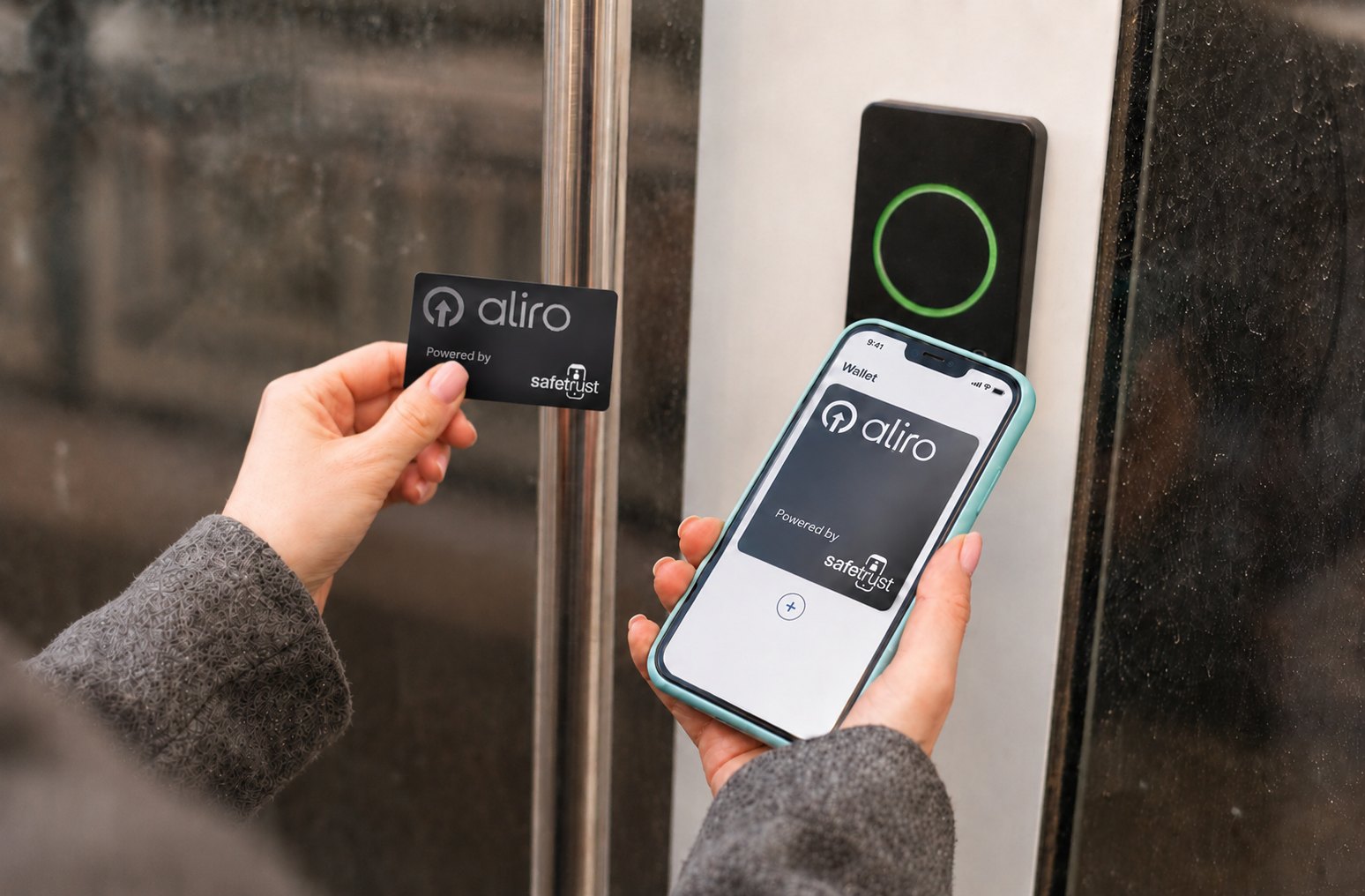
The consequential promise of Aliro is not that a phone can open a door. That is already possible. It is that certified devices from different manufacturers could speak the same language at the door. When the Connectivity Standards Alliance released Aliro 1.0 on February 26, it described support from Apple, Google and Samsung alongside access-control manufacturers. That combination makes interoperability a commercial question as well as an engineering one. Aliro 1.0 announcement, February 26, 2026
Our central finding is a shift in where dependence can accumulate. A more interchangeable reader does not automatically create an interchangeable access service. Someone still issues a credential, connects it to an employee, decides which doors it opens and revokes it when circumstances change. As physical access becomes more automated, that permission-management layer may become more strategically valuable than the credential format itself.
The old constraint sat at the doorway
A building owner replacing access equipment must consider more than the price of a reader. Existing credentials, phone support, backend integration and the experience of thousands of users can make a supposedly modest hardware decision expensive. A proprietary relationship between a device and its credential can narrow the available choices before an installer reaches the door.
Aliro addresses a defined part of this problem: communication and credentials between user devices and readers. The Alliance describes NFC for tapping, Bluetooth LE for user-initiated access, and Bluetooth LE with ultra-wideband for hands-free use. These are supported modes in a specification, not proof that every shipping reader supports every experience. Certification and the capabilities of each product still matter. Aliro's defined scope
A standard is the start of a migration
Safetrust's announcement of an Aliro migration credential illustrates the practical next step: organizations need a route from existing access systems into the new ecosystem. The significance is the migration problem itself. Buyers rarely replace every lock, reader, badge and employment system at once. A transitional product can matter more to adoption than a pristine demonstration of two brand-new devices. Safetrust's migration announcement
Consider a hypothetical office with modern readers at its main entrance and older equipment at its loading area. A new credential that works only at the entrance has not simplified the employee's working day. The company needs to establish which combinations work, what remains dependent on legacy credentials, and how it will handle visitors and contractors during the transition. None of these questions is answered by a standards logo alone.
There is another interface behind the reader. SIA's Open Supervised Device Protocol addresses communication between access-control devices, including readers and controllers. It is a different layer from a phone-to-reader credential standard. Treating the two as substitutes risks leaving an older part of the access chain unexamined. An interoperable front end can still connect to a poorly governed backend. SIA's OSDP overview
The unexpected prize is permission management
The useful way to assess Aliro is to follow one credential through its entire life. Who can issue it? How is the right employee identified? What happens after a lost phone? How quickly can access be removed? Can the organization export its permission history if it changes service providers? These are questions about control of an operating process, not just compatibility at an opening.
This is where autonomy enters the story. Software can increasingly turn a hiring event, approved visit or changed work assignment into a physical permission. That can reduce administrative delay. It can also propagate a mistaken identity or an overbroad role into many doors at once. The advantage belongs to a system that makes those transitions dependable and reviewable, rather than merely fast.
For startups, the opportunity may therefore lie between the identity system and the building. For established vendors, an open credential could remove one form of lock-in while creating pressure to compete on lifecycle management. This is an analytical possibility, not a forecast of which company will win. Interoperability could also encourage simpler, lower-cost services rather than a new dominant platform.
What would weaken this thesis?
The strongest counterargument is that credential interoperability itself may deliver most of the value. A buyer with uncomplicated permissions and reliable existing administration might mainly need fewer compatibility failures. Such an organization may have little reason to purchase another orchestration layer. Nor does a new standard guarantee rapid adoption; installed hardware, certification costs and user habits can slow migration.
Those limits suggest a better test than counting supporting brands. Follow real mixed-vendor deployments through onboarding, revocation, replacement and an outage. Measure the work required at each stage. If changing a reader becomes easy but changing the permission service remains costly, dependence has moved. If both become easier, the standard will have helped create a more open market in a much broader sense.
Watch the exit as closely as the entrance
The next revealing evidence will be customers switching part of an access system without re-enrolling everyone or rebuilding their permission records. A polished tap-to-unlock demonstration proves a useful interaction. A clean provider transition proves freedom to choose. For autonomous access, the enduring question is who retains authority over the permission after the key becomes portable.
References
Questions, news tips or corrections? Contact [email protected].